Flame Arrester Monitoring
Digitalizing Safety Maintenance for Critical Process Equipment
In high-risk sectors such as petrochemicals, fine chemicals, pharmaceuticals, and emerging fields like biogas and carbon capture, operational safety is non-negotiable. Global regulatory pressures, coupled with the inherent dangers of handling flammable and explosive gases, mandate the use of highly reliable safety devices. Among these critical components, the Flame Arrester stands out. Typically installed on storage tank vents, flare stack headers, or within vapor recovery units (VRUs), its fundamental role is to prevent the propagation of external fire or detonation waves into equipment or piping systems containing hazardous media. This is achieved through a carefully designed element (often crimped metal ribbon) that absorbs heat and quenches the flame, effectively isolating the source of the ignition.
However, the very design feature that makes the flame arrester effective—its intricate, high-surface-area element—also makes it highly susceptible to fouling. Over time, process gases carry particulates, crystallized materials, dust, or sticky residues that progressively accumulate within the narrow channels of the arrester element. This phenomenon, known as clogging or fouling, is the primary enemy of efficient and safe operation. As the channels narrow, the resistance to fluid flow increases dramatically, leading to a significant build-up of differential pressure across the device.
The consequences of unmonitored clogging are severe. Increased pressure drop reduces process efficiency, potentially starving downstream equipment of necessary flow. More critically, an excessive backpressure can compromise the structural integrity of connected vessels, leading to tank deformation or catastrophic failure, or it can interfere with upstream process stability. Traditionally, maintenance relied on time-based schedules or costly, often hazardous, manual inspection and disassembly. This reactive or preventative approach is inherently inefficient: cleaning too early wastes valuable maintenance resources; cleaning too late invites severe safety risks and operational downtime.
The modern industrial trend is an accelerating shift toward Condition-Based Monitoring (CBM) and Predictive Maintenance. To effectively manage flame arrester health in real-time, online monitoring of the single most indicative parameter—the pressure difference—is essential. While high-end, high-accuracy transmitters are available, their cost often prohibits widespread deployment across hundreds of monitoring points within a facility, particularly on auxiliary systems or breathing vents. This market gap created a definitive demand for the Economic Differential Pressure Transmitter: a product that delivers the requisite accuracy, ruggedness, and reliability for critical safety monitoring at a significantly optimized cost profile, enabling comprehensive, plant-wide asset coverage and ensuring safety without budgetary excess.
II. Solution Implementation: ZINACA Instruments’ Economic Ex d Differential Pressure Transmitter for Differential Pressure Monitoring
The application of the differential pressure transmitter is the most direct and scientifically sound method for diagnosing flame arrester health. Our ZINACA Instruments Economic Differential Pressure Transmitter is engineered specifically for this critical task, providing a robust and cost-effective solution for continuous condition monitoring. The device is installed with two impulse lines tapped immediately before (high-pressure side, P1) and immediately after (low-pressure side, P2) the flame arrester. The transmitter continuously measures the pressure difference, which is commonly referred to as Delta P (P1 minus P2).
In a clean, optimally functioning arrester, the measured Delta P is minimal, representing the design’s inherent flow resistance. As particulate accumulation leads to fouling, the flow constriction intensifies, causing the energy required to push the fluid through the device to rise sharply. This is immediately reflected as a marked increase in the measured Delta P. By converting this physical pressure change into a standard electrical signal (the ubiquitous 4-20mA analog output or RS485 digital output), our transmitter provides real-time data to the facility’s control system (DCS or PLC). When the differential pressure reading crosses a predetermined alarm threshold—often set based on regulatory compliance limits (e.g., as per ISO 16852)—an automatic alert is generated, signaling the maintenance team that immediate cleaning or replacement is required. This system eliminates guesswork and shifts maintenance from a fixed schedule to a necessary condition.
A critical design consideration for this application is balancing cost-effectiveness with safety in hazardous areas. Many flame arrester installations are in Zone 1 or Zone 2 locations where flammable gases are present. To meet this stringent requirement, our economic line focuses on the Explosion-Proof (Ex d) Protection concept. The transmitter housing is robustly constructed to contain any potential explosion that might occur internally, preventing the ignition from propagating to the external, hazardous atmosphere.
Our product’s specific technical advantages for flame arrester monitoring include: Exceptional Low-Range Sensitivity: Flame arresters typically operate at very low pressure drops (often in the range of 0 to 50 mbar or 0 to 5 kPa). Our sensors utilize highly sensitive piezoresistive or capacitive sensing elements that provide excellent stability and linearity across these micro-differential ranges. Wired Reliability: Designed for long-term stability in critical applications, the transmitters provide standard wired outputs (4-20mA / RS485). This robust connectivity ensures uninterrupted data flow to the control room. Rugged Construction: While maintaining cost-efficiency, the enclosure is built for durability, featuring an IP65 ingress protection rating to withstand dust penetration and low-pressure water jets, making it perfectly suited for permanent outdoor mounting.
Economic Ex Differential Pressure Transmitter for Differential Pressure Monitoring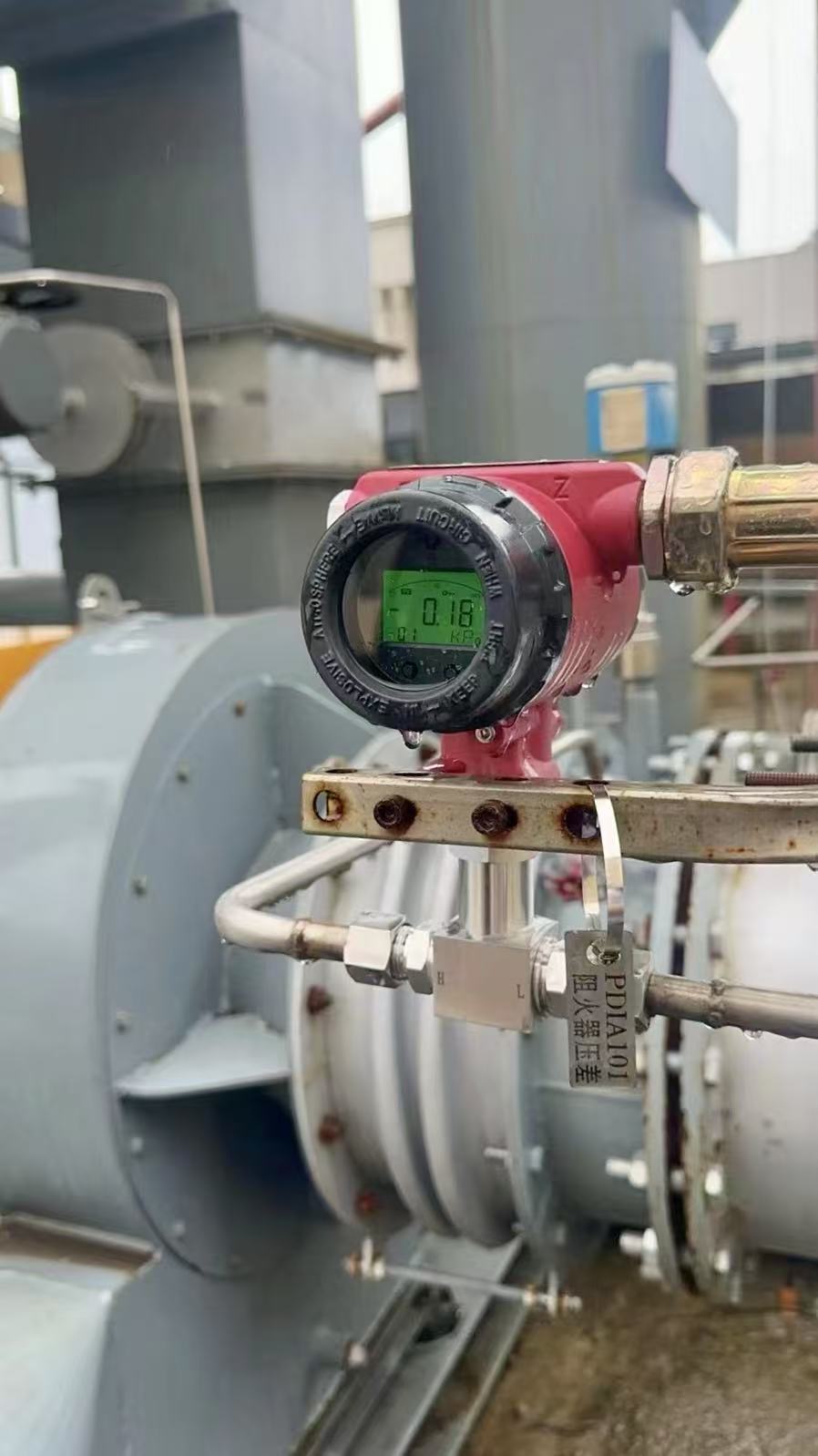
The application of the differential pressure transmitter is the most direct and scientifically sound method for diagnosing flame arrester health. Our ZINACA Instruments Economic Differential Pressure Transmitter is engineered specifically for this critical task, providing a robust and cost-effective solution for continuous condition monitoring. The device is installed with two impulse lines tapped immediately before (high-pressure side, P1) and immediately after (low-pressure side, P2) the flame arrester. The transmitter continuously measures the pressure difference, which is commonly referred to as Delta P (P1 minus P2).
In a clean, optimally functioning arrester, the measured Delta P is minimal, representing the design’s inherent flow resistance. As particulate accumulation leads to fouling, the flow constriction intensifies, causing the energy required to push the fluid through the device to rise sharply. This is immediately reflected as a marked increase in the measured Delta P. By converting this physical pressure change into a standard electrical signal (the ubiquitous 4-20mA analog output or RS485 digital output), our transmitter provides real-time data to the facility’s control system (DCS or PLC). When the differential pressure reading crosses a predetermined alarm threshold—often set based on regulatory compliance limits (e.g., as per ISO 16852)—an automatic alert is generated, signaling the maintenance team that immediate cleaning or replacement is required. This system eliminates guesswork and shifts maintenance from a fixed schedule to a necessary condition.
A critical design consideration for this application is balancing cost-effectiveness with safety in hazardous areas. Many flame arrester installations are in Zone 1 or Zone 2 locations where flammable gases are present. To meet this stringent requirement, our economic line focuses on the Explosion-Proof (Ex d) Protection concept. The transmitter housing is robustly constructed to contain any potential explosion that might occur internally, preventing the ignition from propagating to the external, hazardous atmosphere.
Our product’s specific technical advantages for flame arrester monitoring include: Exceptional Low-Range Sensitivity: Flame arresters typically operate at very low pressure drops (often in the range of 0 to 50 mbar or 0 to 5 kPa). Our sensors utilize highly sensitive piezoresistive or capacitive sensing elements that provide excellent stability and linearity across these micro-differential ranges. Wired Reliability: Designed for long-term stability in critical applications, the transmitters provide standard wired outputs (4-20mA / RS485). This robust connectivity ensures uninterrupted data flow to the control room. Rugged Construction: While maintaining cost-efficiency, the enclosure is built for durability, featuring an IP65 ingress protection rating to withstand dust penetration and low-pressure water jets, making it perfectly suited for permanent outdoor mounting.
How to Choose a Reliable Product and Application Notes
To ensure the safety system is robust and the investment is sound, meticulous selection of the differential pressure transmitter is essential. Choosing a reliable product goes beyond simply comparing price tags; it involves a detailed evaluation against specific operating conditions.
Material Compatibility: The Corrosion Barrier. The most common cause of early transmitter failure in this field is chemical incompatibility. Before purchasing, the end-user must provide a detailed chemical composition of the measured gas. While 316L stainless steel is adequate for most clean, inert gases, highly corrosive media necessitate upgrading the wetted parts to specialty alloys, such as Hastelloy C-276.
Range Selection and Overload Protection. Selecting the correct measurement range is critical for accuracy. The ideal range should be determined based on the flame arrester manufacturer’s specified maximum allowable pressure drop (Delta P max), typically setting the transmitter range to approximately 1.5 times the Delta P max. Crucially, buyers must investigate the Static Pressure Limit and Overload Capability. A reliable economic transmitter must be designed to withstand a significant overpressure (often 5 to 10 times the full-scale range) without physical damage to the sensing element.
Environmental and Safety Compliance. Since flame arresters are often situated in external, non-sheltered locations, the transmitter must be built to endure harsh weather. The required IP65 ingress protection rating ensures the housing prevents the intrusion of dust and protects the internal electronics from water projected from any direction. Furthermore, the economic transmitter selected must hold the necessary Explosion-Proof (Ex d) Certification from a recognized international body if installed in a hazardous location.
Long-Term Stability and Calibration. Outdoor temperature swings can cause zero-point drift in sensors lacking proper thermal compensation. A reliable transmitter, even an economic one, integrates sophisticated electronics and algorithms to compensate for temperature variations across its operating range (e.g., -20°C to 80°C). Our product line exclusively uses the reliable 4-20mA or RS485 wired output system, favored for its stability and minimal maintenance in continuous monitoring applications.
About ZINACA Instruments: Specializing in Rugged, Economic Sensing Solutions
ZINACA Instruments is a specialized technology company dedicated to the research, development, and manufacturing of high-performance, cost-effective instrumentation for industrial process control and safety monitoring. We recognized the significant gap between the need for comprehensive safety monitoring and the budgetary constraints facing facility managers, particularly in applications like flame arrester monitoring. Our focus is to deliver reliable, robust, and precision-engineered sensors that maximize return on investment (ROI) without compromising safety standards.
Our engineering team comprises experts in micro-differential pressure sensing technology, materials science, and explosion protection circuit design. This deep in-house expertise allows us to provide solutions that are perfectly tailored to the unique challenges of industrial environments.
We prioritize quality assurance above all else. Every ZINACA Instruments transmitter undergoes a stringent, multi-stage quality control process in our state-of-the-art facility. This includes Automated Calibration, Thermal Cycling and Aging Tests, and Pressure Overload Testing. Specifically for hazardous areas, our core commitment to Explosion-Proof (Ex d) protection ensures that our economic solutions provide maximum physical safety and compliance with the most demanding industrial regulations. This design philosophy translates into transmitters that are not only affordable but also physically resilient, ready to perform reliably in exposed, non-sheltered locations while maintaining the necessary IP65 ingress protection rating.
Choosing ZINACA Instruments means partnering with a manufacturer that understands the criticality of your process and the need for fiscal prudence. We offer comprehensive technical support—from initial application analysis and product selection to installation guidance and long-term servicing.
 WhatsApp
 Email
Email
 +8617320288925