How to Select the Right Radar Level Transmitter?
Selecting the correct radar level transmitter is critical for ensuring measurement accuracy and long-term stability. The selection process must balance media characteristics, process conditions, and installation environments. As an expert in industrial instrumentation, ZINACA Instruments provides this technical roadmap to help you choose the ideal solution for your application.
Evaluate Media Characteristics
The nature of the substance being measured dictates the required radar frequency and antenna material.
Physical State:
Liquids: For corrosive media such as sulfuric acid, select PTFE-coated antennas. For volatile or viscous liquids, non-contact high-frequency radar is preferred.
Solids and Powders: For high-dust environments like cement or fly ash, use 76GHz or 80GHz High-Frequency Radar to penetrate dust clouds effectively.
Dielectric Constant (Er):
High Er (greater than 10): Water-based solutions reflect signals strongly. Standard frequency radars are usually sufficient.
Low Er (less than 10): Oils, hydrocarbons, and solids reflect signals weakly. High-frequency radar (26GHz or 80GHz) is required to amplify the return echo.
Surface Condition:If the surface has heavy foam, a Guided Wave Radar (GWR) is often more reliable as it uses Time Domain Reflectometry (TDR) to penetrate the foam layer.
Analyze Process and Environmental Conditions
Pressure and Temperature:
Standard: -40 degrees Celsius to 120 degrees Celsius.
Extreme: For high-temperature steam or molten liquids, use High-Temperature Antennas (up to 250 degrees Celsius and above) equipped with cooling or purging systems. For high-pressure vessels, ensure the flange rating meets PN16 or higher.
Vapor and Steam:High-frequency units (26 GHz and above) have stronger penetration through thick steam and fog than low-frequency models.
Obstacles:If the tank has agitators or heating coils, select a radar with False Echo Suppression software to filter out interference from internal structures.
Determine Installation and Antenna Types
Proper installation prevents signal loss and minimizes the dead zone.
Antenna Selection:
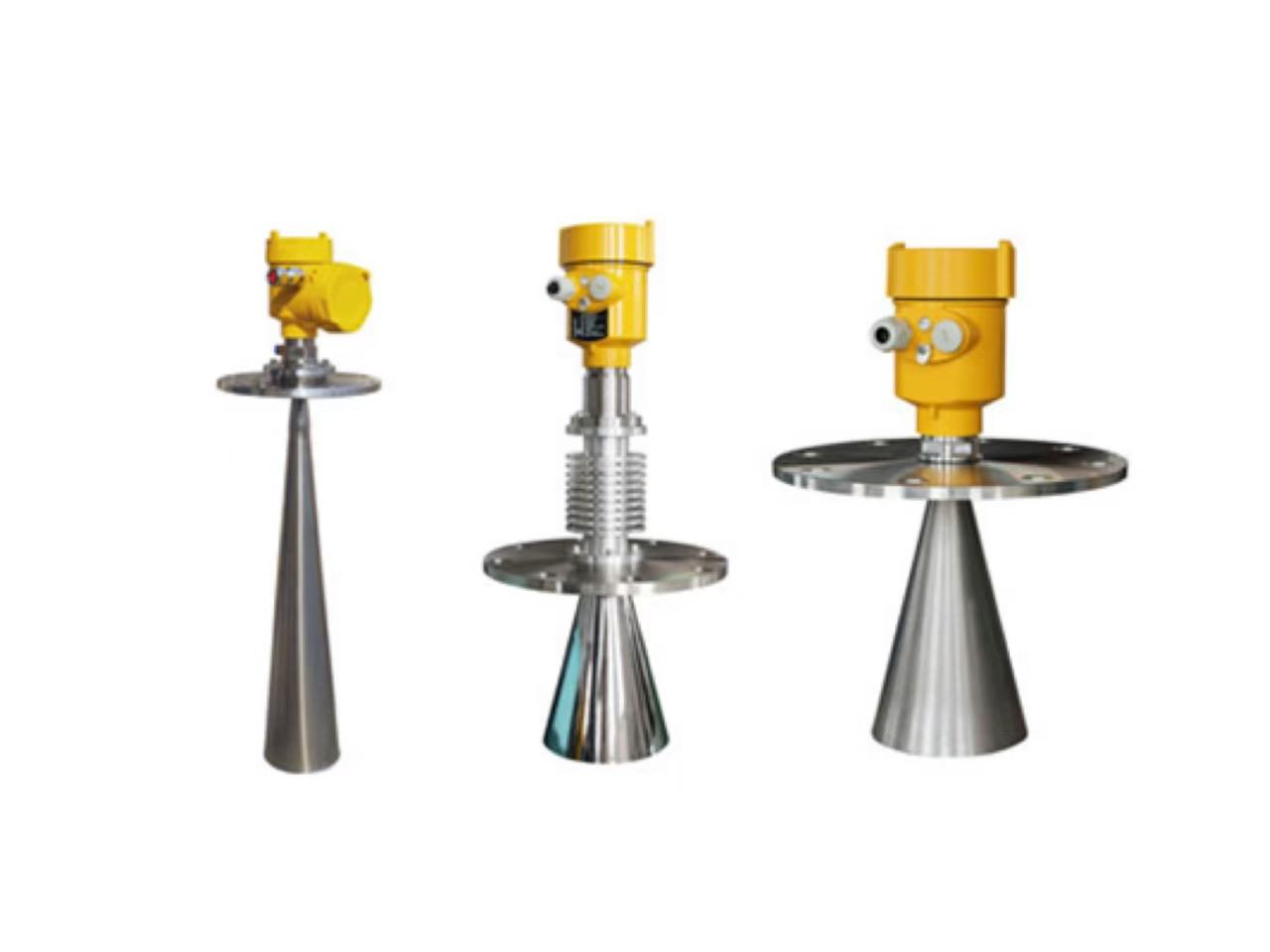
Horn Antenna: Standard for solids and liquids; excellent dust resistance.
Parabolic Antenna: High focus, ideal for long-range measurement in large storage tanks.
Planar Antenna: Compact, best for small tanks or limited-space environments.
Guided Wave Rod or Cable: Best for low Er liquids or turbulent surfaces.
Placement: Install at least 200mm away from the tank wall and avoid placing the beam directly over the material inlet to prevent noise.
Communication and Integration
Modern industrial plants require seamless data integration. ZINACA transmitters support:
Analog: 4-20mA with HART protocol for smart diagnostics.
Digital: RS485, Modbus, or Profibus for automated system integration.
Local Interface: LCDs for on-site monitoring and Bluetooth or USB support for mobile app configuration.
Summary: Quick Selection Reference
| Industry | Media Type | Recommended Radar | Key Feature |
| Petrochemical | Fuel, Oil, Gas | 26GHz/80GHz + Parabolic | Low Er and Vapor resistance |
| Water Treatment | Sewage, Sludge | 5.8GHz/26GHz + Rod | Corrosion resistance |
| Food & Pharma | Syrup, Juice | 26GHz Planar (SS316L) | Hygienic design & Anti-clogging |
| Power & Mining | Coal Powder, Ash | 76GHz/80GHz + Horn | High dust penetration |
At Tianjin ZINACA Intelligent Equipment Co., Ltd., we do not just sell hardware; we provide customized measurement solutions. Our radar series is engineered to withstand extreme pressures and corrosive environments while maintaining millimeter-level precision.
Verify your selection today. Visit www.zinacainstruments.com or contact our technical team to discuss your specific process requirements.
 WhatsApp
 Email
Email
 +8617320288925