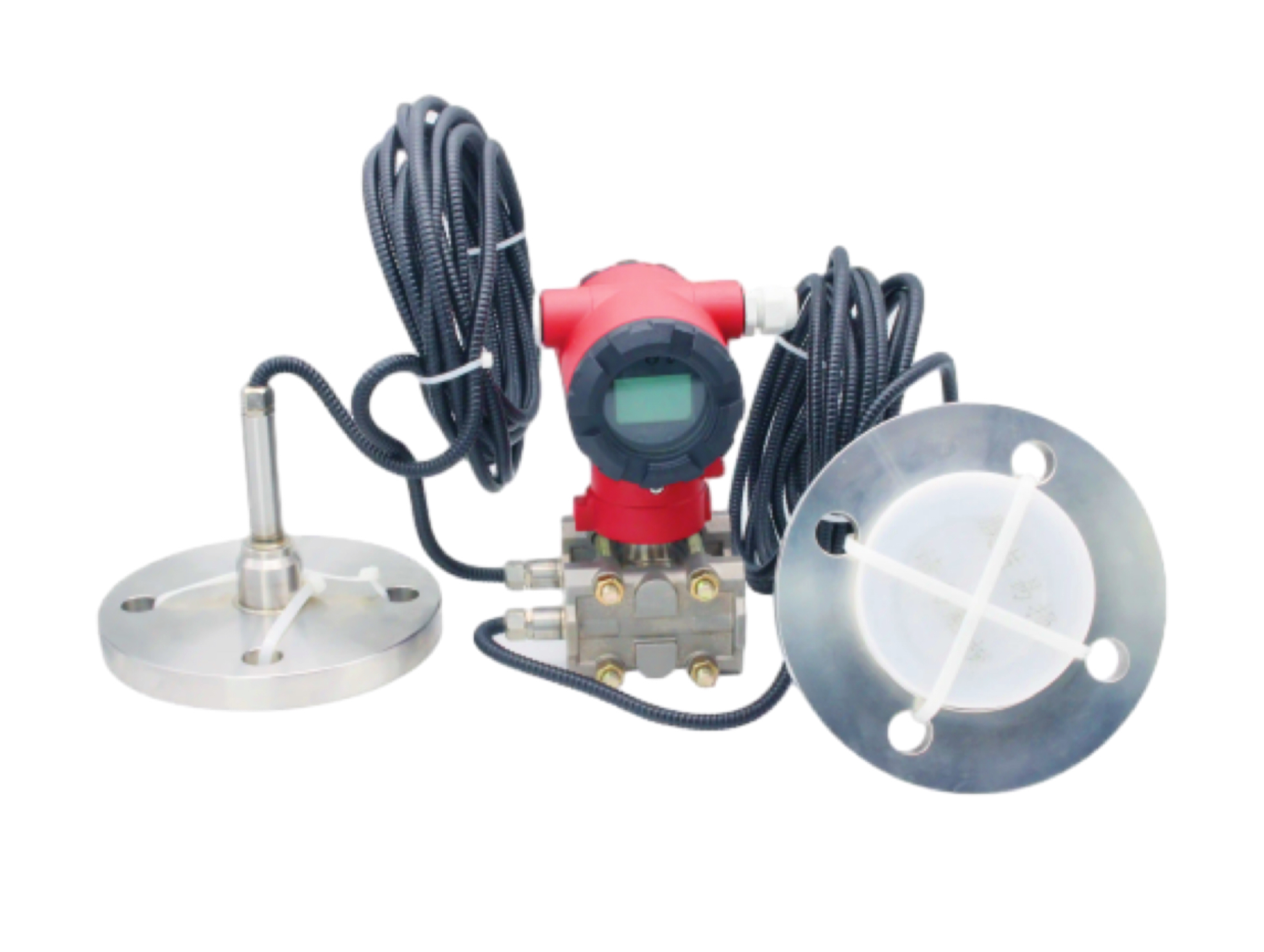
What is a Diaphragm Seal Pressure Transmitter?
In heavy industries such as petrochemicals, food and pharmaceuticals, and pulp and paper, many process media possess extreme characteristics: high temperature, high viscosity, crystallization risk, strong corrosivity, or solid particles. These media can cause severe damage, blockage, or contamination to the sensitive isolating diaphragms and process connections of conventional pressure transmitters, leading to inaccurate measurements and premature equipment failure.
The Diaphragm Seal Pressure Transmitter is designed specifically to overcome these formidable challenges. It is not a new type of sensing technology, but rather a complete measurement system that integrates a standard pressure (or differential pressure) transmitter with one or more remote diaphragm seal assemblies.
Through a system of filling fluid and capillary tubes, the diaphragm seal safely and accurately transmits the process pressure to the transmitter body while keeping the transmitter’s sensitive electronics completely isolated from the harsh process media. This design ensures high-precision and high-stability measurement and significantly extends the service life of the equipment in challenging operating conditions.
What is a Diaphragm Seal Pressure Transmitter?
A Diaphragm Seal Pressure Transmitter is a complete measurement system consisting of a transmitter body, a diaphragm seal element, and a filling system. Its primary function is to accurately measure process pressure or differential pressure while simultaneously providing a physical barrier between the sensitive measuring components and the aggressive process medium.
The transmitter body is typically a high-performance smart transmitter, such as ZINACA’s monocrystalline silicon sensor type, responsible for converting the pressure signal into a standard 4-20 mA + HART output.
The Diaphragm Seal is the part that directly contacts the process medium, consisting of a flexible, corrosion-resistant metal diaphragm. The Filling System includes the capillary tube connecting the diaphragm seal to the transmitter body, and the fill fluid contained within the entire sealed system.
Key characteristics include:
Media Compatibility achieved by selecting corrosion-resistant diaphragm materials such as Hastelloy or Tantalum.
High-Temperature Adaptation, which uses high-temperature fill fluids and capillary tubes to displace the transmitter body from the heat source.
Anti-Clogging Design, often featuring a flush mount to prevent highly viscous media from blocking the connection.
And Remote Installation, allowing the transmitter body to be installed in a safer, more accessible area.
How Does a Diaphragm Seal Transmitter Work?
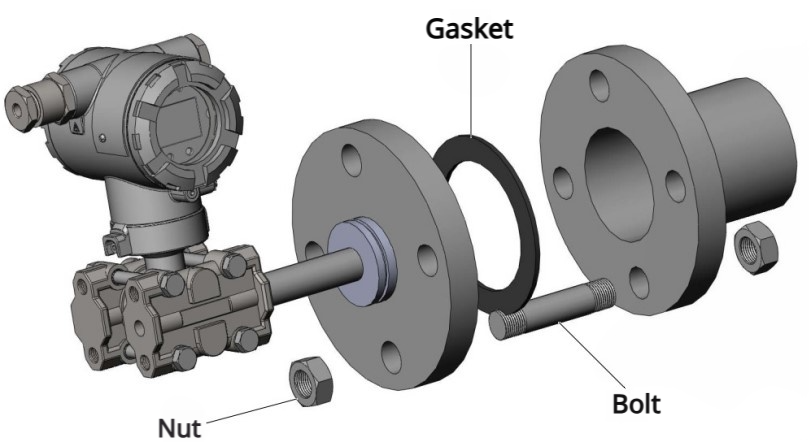
The principle of operation relies on basic hydrostatic principles: the pressure exerted on the seal diaphragm is transmitted accurately to the distant transmitter sensor via an incompressible fill fluid.
The process pressure (P) acts upon the flexible metal diaphragm of the seal assembly, causing a minute deflection. This deflection generates an equivalent hydraulic pressure within the sealed cavity containing the fill fluid.
According to Pascal’s Principle, the fluid accurately transmits this hydraulic pressure signal through the capillary tube to the sensing element inside the transmitter body.
The transmitter body's sensor (e.g., a monocrystalline silicon sensor) receives this pressure and converts it into a weak electrical signal.
The built-in microprocessor then executes digital correction algorithms such as Temperature Compensation (TSC), linearization, and Automatic Zero Tracking (ZSC) to ensure signal accuracy.
A critical factor is addressing Temperature Effects: The Fill fluid expands or contracts with temperature fluctuations. Smart transmitters minimize this issue through a complex digital compensation algorithm, ensuring high accuracy (up to ± 0.05%) even in extreme temperatures. The system ultimately outputs a standard 4-20mA + HART signal.
Applications of Diaphragm Seal Transmitters
The Diaphragm Seal technology is vital in harsh operating conditions where standard sensors would fail.
Primary application areas include:
High Temperature Processes, where the system protects electronics from media potentially exceeding 350°C. Highly Corrosive Media, where corrosion-resistant diaphragm materials like PTFE coating are used to measure chemicals safely.
High Viscosity and Crystallizing Media, where the flush diaphragm design eliminates dead spaces, preventing media like tar or polymers from blocking the connection.
Food and Pharmaceutical Industries, which require hygienic standards using Tri-Clamp connections for easy cleaning and sterilization (CIP/SIP).
And Media with Solid Particles, where the large diaphragm surface area disperses wear and avoids clogging by materials like slurries or mud.
Types of Diaphragm Seal Transmitters
Diaphragm seal systems are classified primarily by the number of seals and the process connection method.
Classification by Number of Seals includes:
Single Diaphragm Seal Systems, used for gauge or absolute pressure measurement, feature one seal element.
Double Diaphragm Seal Systems, used for differential pressure or level measurement in closed vessels, feature two separate seal elements.
Classification by Process Connection includes:
Threaded Connections for general chemical use; Flanged Connections for high pressure and large bore piping;
Flush Diaphragms for highly viscous or crystallizing media, and Hygienic (Tri-Clamp) connections for the food and pharmaceutical sectors.
How to Choose the Right Diaphragm Seal Transmitter?
Selecting the correct unit requires systematic evaluation.
First, check Media Compatibility: The diaphragm material must be completely resistant to the medium (e.g., Tantalum for strong acids).
Second, assess Temperature Compatibility: The correct fill fluid (e.g., high-temperature oil) and capillary length must be selected to match the process temperature.
Third, consider Connection & Anti-Clogging: High viscosity or solids require a flush face flange connection.
Fourth, evaluate Capillary Length and Accuracy: Choose the shortest length required to minimize temperature-induced error.
Finally, confirm System Requirements: Ensure the required output 4-20 mA/HART and safety certifications IP65, Ex dⅡ C T6 Gb) are met.
Diaphragm Seal Transmitter Price
The price of a Diaphragm Seal Transmitter system varies significantly with actual parameters, material choices, configuration complexity, and capillary length.
Key factors influencing the price include: Diaphragm Material (special alloys are more expensive), Seal Type (hygienic or custom seals cost more), Capillary System (length and specialized fill fluid), and Transmitter Body Configuration (accuracy class and certifications).
If you would like to know the latest price of ZINACA’s Diaphragm Seal Transmitter, please contact us for a detailed quotation.
Custom Differential Pressure Transmitter OEM Service
ZINACA Instruments is a professional industrial instrumentation manufacturer specializing in highly customized solutions. Diaphragm seal systems often require customization based on the client’s specific working conditions.
Our OEM Service Advantages include:
Custom Material and Coating to address specific corrosion;
Special Connection Customization for non-standard interfaces;
Temperature Optimization through precise calculation of the capillary system and high-accuracy temperature compensation algorithms, and Branding and Certification assistance.
If you are looking for Diaphragm Seal Transmitter OEM Service, please feel free to contact us. ZINACA Instruments looks forward to providing you with precise, durable measurement systems.
Differential Pressure Transmitter Supplier
Choosing an experienced supplier capable of providing reliable, customized services is key to the successful measurement of complex processes. As a trusted Diaphragm Seal Pressure Transmitter Manufacturer, ZINACA Instruments provides reliable measurement assurance for global industrial applications, leveraging its high-performance transmitter bodies (high-accuracy monocrystalline silicon sensors) and expert seal system integration techniques.
We ensure every diaphragm seal system is precisely calculated and vacuum-filled to minimize temperature effects and maximize accuracy.
Please contact ZINACA Instruments for more information, technical specifications, and custom services for our high-performance diaphragm seal transmitters, helping you solve your most demanding measurement challenges.
 WhatsApp
 Email
Email
 +8617320288925