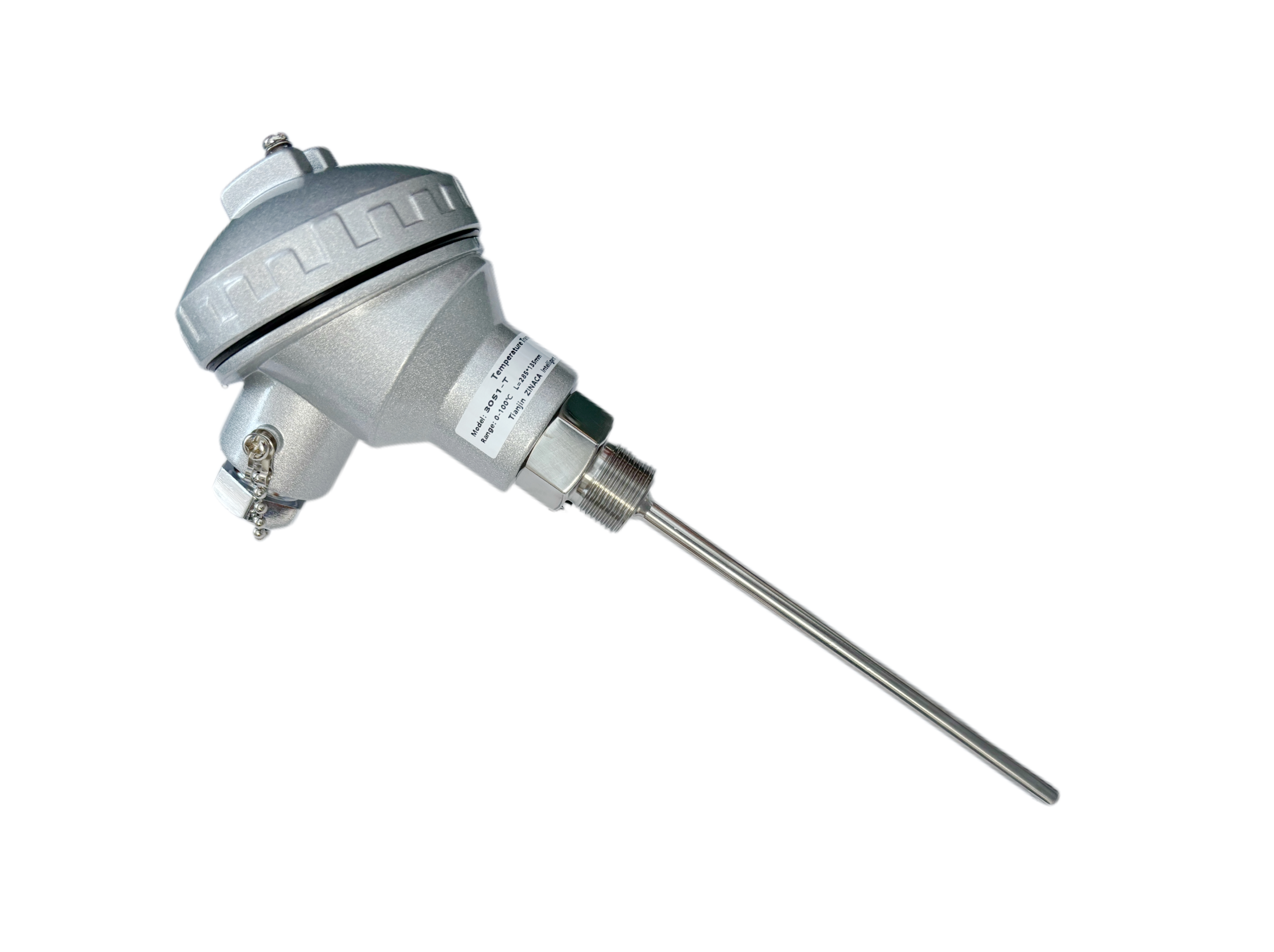
What is an RTD?
Overview of RTD
In modern industrial automation, energy management, food processing, pharmaceuticals, and scientific research, accurate and stable temperature measurement is crucial for ensuring product quality, process efficiency, and system safety. Among the various temperature sensors available, the Resistance Temperature Detector (RTD) stands out as one of the most reliable instruments due to its superior high accuracy, excellent repeatability, and long-term stability.
RTD sensors operate based on the principle that the electrical resistance of a metallic conductor changes predictably with temperature. Essentially, it is a passive device that measures the surrounding temperature by measuring its own resistance and then correlating that value with a known resistance-to-temperature (R-T) relationship. The most common and widely applied type is the Pt100 sensor, which uses Platinum as the sensing material and exhibits a nominal resistance of 100 Ohms at 0 degrees C.
This article will delve into the working principle, core advantages, main types, and critical applications of RTDs across various demanding industrial environments, providing you with a complete and professional guide to RTD technology.
What is an RTD?
Definition and Core Principle
An RTD is a highly accurate temperature sensor that utilizes the physical property that the electrical resistance of certain metal conductors (such as Platinum (Pt), Copper (Cu), or Nickel (Ni)) changes predictably as their temperature changes.
Core Principle: As temperature increases, the thermal vibration of atoms within the conductor intensifies, impeding the flow of electrons, and causing the resistance to increase. The RTD measures this change in resistance and, based on the Resistance-Temperature (R-T) characteristic curve defined by international standards, calculates the precise temperature value.
The general mathematical model for the RTD (often using the Callendar-Van Dusen equation) can be conceptually understood as: Resistance at Temperature T equals Resistance at 0 degrees C times a factor involving temperature and material constants.
Key Differences from Thermocouples
RTD (Resistance Temperature Detector) uses Resistance change (R-T relationship) while the thermocouple uses the thermoelectric effect (Seebeck effect). RTD offers High accuracy (plus minus 0 dot 1 degree C to plus minus 0 dot 5 degree C), excellent linearity, compared to the thermocouple, which is lower but good across a wide range. RTD has a Moderate measurement range (minus 200 degrees C to 850 degrees C) while Thermocouple has a Wide range (minus 270 degrees C to 2300 degrees C). RTD has Extremely High stability, resistant to drift over time, compared to a thermocouple, which has general long-term stability. RTD requires external excitation current and typically a 3- or 4-wire connection, while a thermocouple is self-powered and typically uses a 2-wire connection.
How Does an RTD Work?
The operation of an RTD involves three critical steps: sensing, resistance measurement, and signal processing.
Sensing Element and Structure
The heart of the RTD is the sensing element, which is typically a Platinum wire or a thin-film element encased within a protective sheath.
Element Types:
Wire-Wound: Fine Platinum wire is precisely wound around a ceramic or glass core. This type offers the highest accuracy and stability but is costlier and has a slower response time.
Thin-Film: A microscopically thin layer of Platinum is deposited onto a ceramic substrate. This is cost-effective, smaller, and faster responding, making it the most common form in current industrial use.
Protective Sheath: To shield the sensitive element from mechanical damage, corrosion, and moisture from the process medium, RTDs are typically mounted inside a sheath made of stainless steel (SS) or Inconel alloy.
Resistance Measurement and Lead Wire Compensation
The RTD is a passive component and requires an external excitation current (usually 1 mA or less) to be passed through the sensor to measure its resistance. Because the resistance value measured by an RTD is relatively small (the Pt100 changes resistance by only about 0.385 Ohms per degree C), the resistance of the lead wires (the cables connecting the sensor to the measuring instrument) and their variation with ambient temperature can significantly impact measurement accuracy.
To mitigate the effect of lead wire resistance, RTDs employ three main wiring configurations:
2-Wire: The simplest, but the least accurate. The lead wire resistance is included entirely in the measurement, making it suitable only for applications where accuracy is not critical and the lead wires are very short.
3-Wire: The industrial standard. It uses three leads, with two used for measuring the loop resistance and one for the reference power. By assuming the resistance of the three leads is equal, the measuring instrument can automatically compensate for and largely cancel the lead wire resistance effect.
4-Wire: The highest accuracy. It uses four leads. Two provide the constant excitation current, and the other two measure the voltage drop directly across the sensor element. This method completely eliminates the effect of lead wire resistance on the measurement and is often used in high-precision laboratory and calibration applications.
Signal Processing and Temperature Conversion
The measured resistance value (R) is converted into a temperature (T) through the following process:
Bridge Circuitry: The RTD is often incorporated into a Wheatstone bridge circuit, which translates the resistance change into a voltage change.
A/D Conversion: A transmitter (or PLC module) amplifies the voltage signal and performs analogue-to-digital conversion.
Linearization: The microprocessor within the transmitter uses the built-in Callendar-Van Dusen equation or a look-up table method to precisely compensate for the slight non-linearity of the Platinum resistance characteristic, effectively linearizing the measurement.
Standard Output: The final reading is output as a standard DC 4-20 mA, Voltage, or digital (HART/RS485) signal to the control system.
Applications of RTD
The superior accuracy and stability of RTD sensors make them the ideal choice for critical applications demanding highly reliable temperature data.
Primary Application Fields
Industrial Process Control:
Boilers and Heat Exchangers: Monitoring steam, water, and oil temperatures to ensure efficient and safe operation.
Reactor Control: Providing high-accuracy temperature feedback in chemical and petrochemical reactors to control reaction rates and product quality.
Food and Beverage Industry:
Pasteurization: Ensuring beverages like milk or beer are held at precise temperatures for required durations to eliminate harmful bacteria.
Hygienic Applications: Using FDA-compliant sanitary RTDs with polished finishes to prevent media contamination.
Energy and Power Generation:
Turbines and Generators: Monitoring bearing, lubrication oil, and winding temperatures to prevent equipment failure due to overheating.
HVAC Systems: Precisely controlling temperature in large commercial buildings for energy efficiency.
Scientific Research and Calibration:
Laboratory Standards: Due to their exceptional stability and accuracy, Platinum resistance thermometers often serve as reference standards for calibrating other temperature sensors.
Types of RTD
RTDs are primarily classified based on their sensing material, R-T characteristics, and mechanical structure.
Classification by Resistance-Temperature Characteristics (Standard Types)
Pt100 (Platinum Resistance):
Characteristic: 100 Ohms resistance at 0 degrees C.
Advantage: Most common, most stable, wide range (minus 200 degrees C to 600 degrees C or 850 degrees C), and the global industry standard.
Pt1000:
Characteristic: 1000 Ohms resistance at 0 degrees C.
Advantage: A higher resistance value means the relative effect of lead wire resistance is smaller, often used in 2-wire connections or low-power applications.
Cu10/Ni120:
Characteristic: Copper and Nickel resistance.
Advantage: Lower cost, but limited application range (typically low temperatures) due to higher non-linearity and susceptibility to corrosion.
Classification by Structure
Probe Type: The most common form. The sensing element is mounted within a robust metal sheath (usually 316L stainless steel) for direct immersion or threading into the process medium.
Surface Mount Type: Designed to measure the temperature of an object's surface, such as pipes or motor housings. Usually, thin-film elements have adhesive backing or screw holes.
Hygienic Type:
Features polished 316L stainless steel with Tri-Clamp or other sanitary connections, used in the food, beverage, and pharmaceutical industries, facilitating CIP/SIP cleaning.
How to Choose the Right RTD?
Selecting the correct RTD requires balancing accuracy requirements, operating temperature range, process compatibility, and cost.
Selection Guide
Determine Sensing Element Type and Characteristics:
Default Choice: Prioritize the Pt100. It offers the best linearity, stability, and widespread compatibility.
High Accuracy/Laboratory: Select a high-accuracy grade (Class A) Wire-Wound Pt100, and use a 4-wire connection.
Choose Wiring Configuration:
Industrial Field/Long Distance: Must use the 3-wire configuration, which is the standard industrial practice for compensating lead wire error.
Absolute Highest Accuracy/Calibration: Use the 4-wire configuration.
Determine Mechanical Structure and Materials:
Corrosive Media: The sheath material must be corrosion-resistant (e.g., Inconel or special coatings). Vibration Environment: Select an RTD with an anti-vibration design or a Mineral Insulated (MI) construction. Process Connection: Determine the necessary threaded, flanged, or sanitary Tri-Clamp connection.
Define Accuracy Tolerance:
The IEC 60751 standard defines tolerance classes: Class A (plus minus 0.15 degrees C at 0 degrees C) and Class B (plus minus 0.3 degrees C at 0 degrees C). Choose based on your process criticality.
RTD Product Price
The product price of an RTD product varies significantly based on actual parameters, material choice, and configuration complexity.
Key factors influencing the price of an RTD include:
1. Sensing Element Type and Accuracy: Wire-wound elements (highest accuracy) are more expensive than thin-film elements. Class A accuracy is more costly than Class B.
2. Wiring Configuration: 4-wire construction typically costs more than 3-wire.
3. Protective Sheath Material and Length: Sheaths made of specialized materials like Inconel or Hastelloy and extra-long probes significantly increase the cost.
4. Transmitter Integration: Smart RTDs that integrate a temperature transmitter (converting the Ohm signal to 4-20 mA / HART output) are more expensive than simple sensing elements.
If you would like to know the latest price of ZINACA’s RTD products, please feel free to contact us for a detailed quotation.
Custom RTD OEM Service
ZINACA Instruments is a professional industrial instrumentation manufacturer. In many specialized or extreme industrial environments, standard RTD products may not meet unique installation, material, or performance requirements.
Our RTD OEM/ODM Service Advantages include:
1. Custom Structure and Length: Tailoring probe diameter, length, and bend to fit specific customer vessel or piping designs.
2. Special Material Customization: Customizing sheath materials (e.g., Titanium, Ceramic) and connection fittings for highly corrosive, high-pressure, or high-vibration environments.
3. Dual-Element and Redundancy Design: Providing dual Pt100 or triple Pt100 redundant designs for fail-safe operation and online calibration in critical applications.
4. Integrated Transmitter Customization: Offering customized temperature transmitter integration to meet specific communication protocols and accuracy demands.
If you are seeking Custom RTD OEM Services, please contact our professional team. We are committed to providing precise, durable, and highly customized temperature measurement solutions.
Supplier of RTD
Choosing a trustworthy RTD supplier means choosing reliable accuracy and long-term stability.
As a high-performance RTD manufacturer, ZINACA Instruments is dedicated to delivering quality products that adhere to the IEC 60751 international standard. Our RTD sensors are widely used in industrial, scientific, and commercial sectors requiring high precision and reliability.
We offer customized solutions ranging from standard Pt100 3-wire probes to complex dual-element systems integrated with HART transmitters.
Please contact ZINACA Instruments to receive more information, technical specifications, and the latest quotation for our high-performance RTD sensors, ensuring your process temperature measurement meets the highest standards.
 WhatsApp
 Email
Email
 +8617320288925