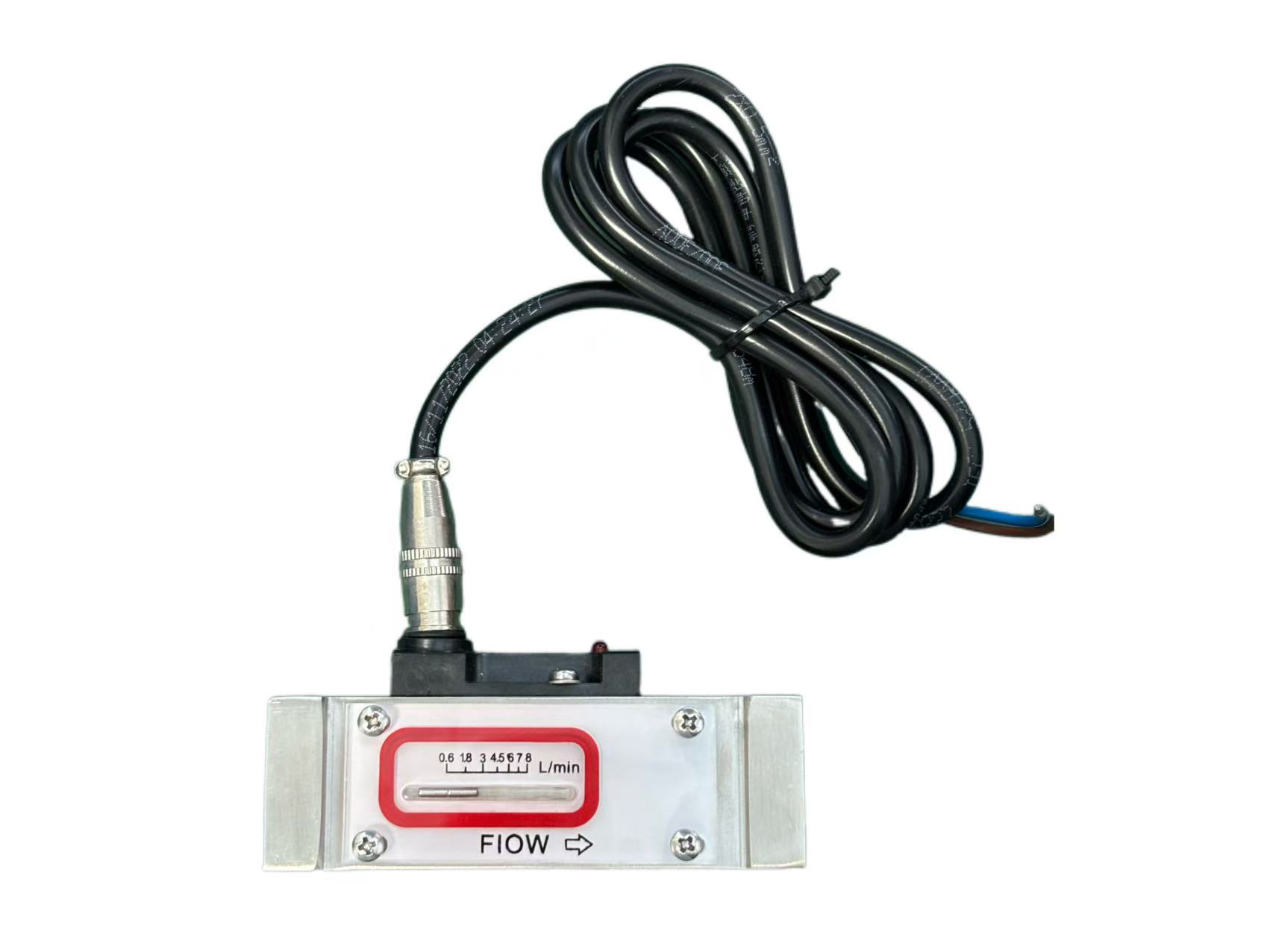
What is a Piston Flow Switch?
In industrial automation and process control, accurately monitoring the flow of liquid or gas is fundamental to ensuring system safety, optimizing efficiency, and protecting critical equipment. Especially in small flow applications, traditional differential pressure or thermal mass flow meters are often costly or slow to respond.
The Piston Flow Switch is designed to meet this exact need. It is a compact, inline mechanical flow switch, recognized for its simple structure, minimal pressure loss, and excellent repeatability, establishing a key role in industrial pipeline monitoring.
This flow switch operates by precisely detecting the force exerted by the medium on an internal piston, thereby achieving ON/OFF flow limit control. With its complete isolation between mechanical and electrical components and pre-calibrated setpoints, the Piston Flow Switch offers outstanding reliability and ease of use. It is widely applied in compressed air systems, HVAC, refrigeration, and various industrial automation processes, making it an ideal choice for small flow monitoring and equipment protection.
What is a Piston Flow Switch?
A Piston Flow Switch is a mechanical-electrical limit switch whose primary function is to output a switch signal when the flow rate reaches or falls below a preset value. It is designed for direct installation in the pipeline for inline flow monitoring.
Core Definition and Structure
Function: To detect whether the velocity of the liquid or gas flowing through the pipeline has reached a predetermined setpoint, and to output a simple switch signal for alarm or control.
Structure: The core is a freely moving piston housed within the casing, typically supported by a spring. Casing materials include durable plastic, aluminum alloy, or stainless steel to suit varying pressures and media environments.
Operation Principle: The movement of the piston directly activates a magnetic reed switch or proximity sensor, converting the mechanical motion into an electrical signal and achieving complete isolation between mechanical and electrical components.
Applicable Media: Suitable for monitoring the flow of both liquid and gas media.
Key Features and Advantages
The Piston Flow Switch possesses several significant industrial advantages due to its unique design:
Minimal Pressure Loss: Due to the compact piston design and optimized flow path, the pressure drop caused by the medium flowing through is minimal, which is crucial for fluid circuits needing to maintain system pressure.
Excellent Repeatability: The precise movement of the mechanical spring and piston ensures the switch point remains highly consistent over multiple triggers, enhancing control reliability.Pre-calibrated Setpoint: Most piston switches are pre-calibrated at the factory according to standard conditions (e.g., water at 20°C), requiring no on-site adjustment, greatly simplifying installation and commissioning.
High Durability: Housing materials (such as stainless steel) can withstand high pressures up to 100 bar, and with an IP65 protection rating, they are suitable for harsh industrial environments.
How Does a Piston Flow Switch Work?
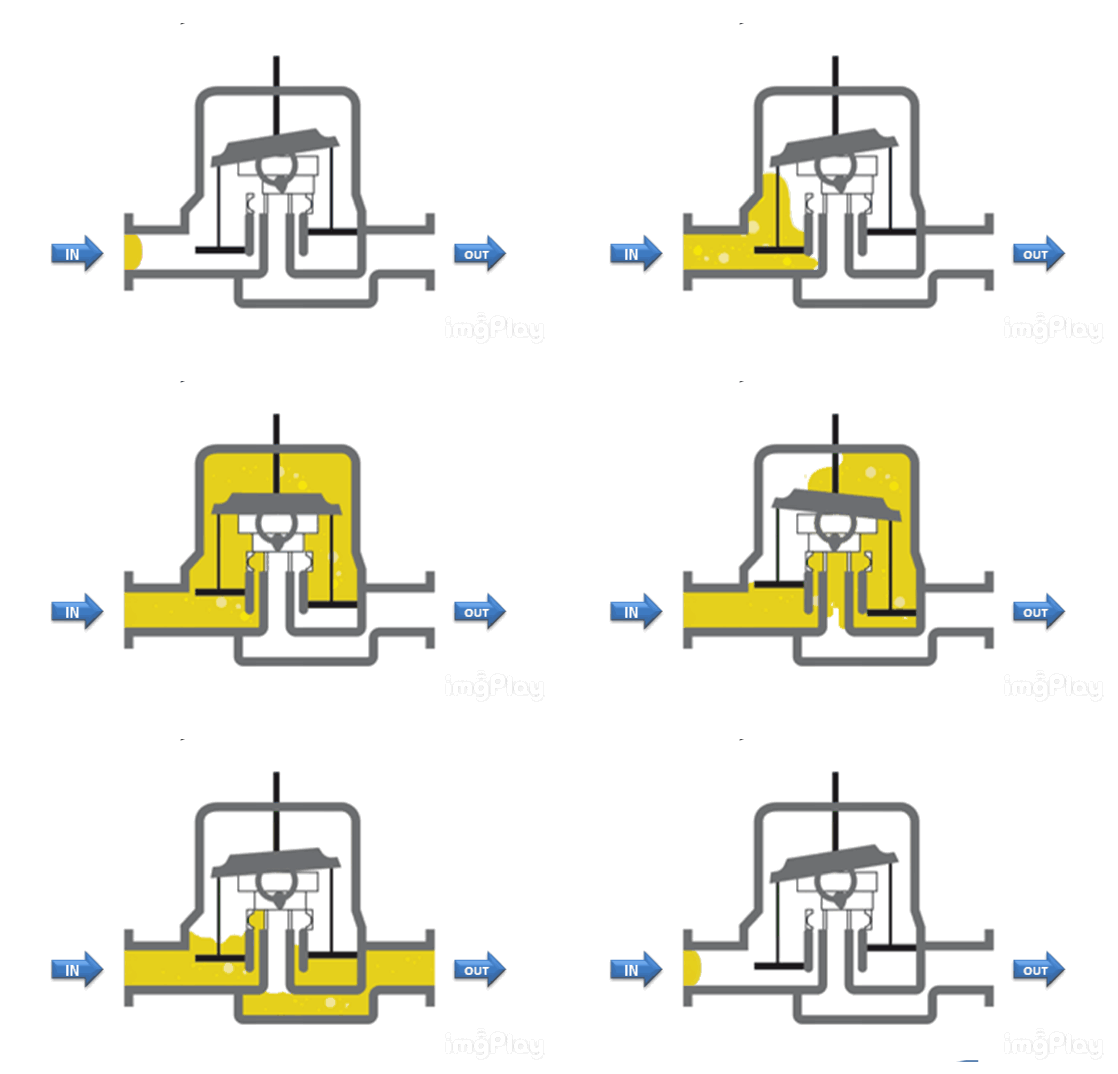
The principle of the Piston Flow Switch is based on a simple combination of fluid dynamics and mechanical balance.
Zero Flow State (Static Balance)
When there is no medium flowing in the pipeline, or the flow is below the set switch value, the piston is held tightly against its initial position (usually the inlet side of the pipe) by the force of its return spring.
At this time, the magnet on the piston is away from the reed switch, and the switch is in an open or normally closed state.
Flow Increase and Piston Displacement
When the medium (liquid or gas) begins to flow through the pipeline, the fluid generates a push force on the front face of the piston.
The fluid force overcomes the spring resistance and begins to push the piston towards the downstream direction of the pipeline. As the flow increases, the distance the piston moves also increases.
Reaching the Setpoint and Signal Output
When the flow reaches the pre-calibrated setpoint, the piston moves precisely to the designed trigger position.
At this position, the magnetic element inside or attached to the piston magnetically couples with the external Reed Switch. The reed switch closes or opens, sending an electrical signal that indicates "flow has reached" or "flow is insufficient."
Hysteresis Phenomenon
Piston switches are designed with hysteresis in mind. This means there is a small difference (e.g., minimum 0.5 L/min) between the switch-on point (when flow is rising) and the reset point (when flow is falling).
Purpose: This ensures the switch does not rapidly cycle (chatter) due to minor flow fluctuations when the flow rate is close to the setpoint, protecting relays and control systems.
Applications of Piston Flow Switch
Due to its reliability and compactness, the Piston Flow Switch has wide-ranging applications for flow limit monitoring and equipment protection.
Key Application Sectors
Industrial Automation:
Monitoring the flow of cooling water, lubricants, or cleaning agents in machinery and process equipment. If the flow is insufficient, the equipment is immediately stopped, or an alarm is raised, preventing overheating or wear.
Compressed Air Systems:
Detecting the flow of compressed air or other inert gases to ensure proper operation of pneumatic tools or to monitor pipeline leaks.
Refrigeration and HVAC:
Ensuring proper circulation of coolant or refrigerant in air conditioning systems, heat exchangers, or chillers, preventing system damage due to flow interruption.
Pump and Circuit Protection:
Preventing Dry Running: A flow switch installed at the pump's outlet immediately shuts down the pump if no flow is detected after startup, preventing dry running and burnout.
Heater Protection: Monitoring water flow in electric heaters or boilers, preventing heating activation when no water is flowing, and avoiding safety incidents.
Small Flow Monitoring:
Providing accurate ON/OFF monitoring for extremely small flow ranges in water treatment, chemical metering, and general industrial pipelines.
Conditions Applicability
The Piston Flow Switch is a cost-effective choice for conditions characterized by:
High repeatability and fast response requirements. Fluid circuits are sensitive to pressure loss . The need for an IP65 dust and water protection rating.
Types of Piston Flow Switch
Piston flow switches are mainly classified by housing material, medium type, and output function, to adapt to different industrial environments and control needs.
Classification by Housing Material
Material determines the switch's pressure resistance and medium compatibility:
Plastic: Suitable for low-cost, non-corrosive media and low-pressure applications, such as water treatment and standard HVAC systems.
Aluminum Alloy: Provides good mechanical strength and pressure resistance (typically up to 50 bar), suitable for oil or general industrial fluids.
Stainless Steel (S304/S316): Offers the highest pressure resistance (up to 100 bar) and excellent compatibility with corrosive media (e.g., certain chemicals).
Classification by Function and Output
Single Switch Output: The most common type, providing a single switch point for a high or low limit alarm. Output is typically a Reed Switch, rated at, for example, 24 VDC / 250 VAC, 100 mA.
Dual Switch Outputs: Provides two independent switch points, allowing for monitoring of both high and low flow limits for more flexible control.
With LED Indicator Models: DC-powered models often include an LED light to visually display the switch status (ON or OFF), facilitating quick field monitoring .
Adjustable Setpoint Models (Less Common): Although most piston switches are pre-calibrated, some designs allow users to adjust the spring tension within a certain range to modify the switch point.
How to Choose the Right Piston Flow Switch?
Selecting the correct Piston Flow Switch requires careful matching of your pipeline parameters, media characteristics, and control requirements.
Selection Checklist
Media Properties: Is the medium liquid or a gas? Is it corrosive? Corrosiveness: Select Stainless Steel (S316) housing and internal seals.
Piping and Pressure: Pipe size and maximum working pressure.
Pressure: Ensure the selected model's pressure resistance (Aluminum 50 bar, Stainless Steel 100 bar) is higher than your maximum working pressure.
Flow Range: The minimum and maximum flow you need to monitor.
Set Range: Refer to the specific parameter table, and choose a model whose setpoint can cover your actual flow range.
Control Requirements: Do you need only one alarm point, or both high and low limits?
Output: Single switch for basic control; dual switch for complex control.
Power Supply and Field Monitoring: Is the power supply DC or AC? Is a field indicator needed?
LED: DC models can provide an LED status indicator for easy field monitoring.
Environmental Conditions: Is there water splash, dust, or extreme temperatures?
Protection Rating: Requires at least an IP65 protection rating.
Piston Flow Switch Price
The price of a Piston Flow Switch varies depending on actual parameters such as material, pressure rating, and configuration.
The primary factors influencing the final cost include:
Housing Material: Stainless steel models typically cost more than aluminum alloy or plastic models.
Pressure Rating: High-pressure resistance (100 bar) models require more robust construction and higher manufacturing precision.
Configuration: Dual switch output, special connectors, or custom calibration will affect the price.
Certification: Costs associated with specific industry certifications (e.g., hygienic or explosion-proof).
If you would like to know the latest ZINACA Instruments' Piston Flow Switch price, please feel free to contact us for a detailed quotation.
Custom Piston Flow Switch OEM
As a professional manufacturer of industrial automation instruments, ZINACA Instruments understands that many industrial applications have unique flow monitoring requirements. We offer customized OEM services to ensure our Piston Flow Switches integrate perfectly into your equipment or process.
Our OEM Service Advantages
Custom Setpoint: Providing special calibration and preset switch values based on your specific medium and flow range.
Material and Connection Customization: Offering non-standard housing materials, seals, or specific process connections (such as threads, flanges).
Private Labeling: Providing private-label production services, including custom labels, colors, and packaging to support your brand building.
Technical Support: Our professional engineering team will assist in design optimization to ensure the switch achieves optimal performance in your specific working conditions.
If you are looking for Piston Flow Switch OEM Service, please feel free to contact us. ZINACA Instruments looks forward to collaborating with you to develop reliable and efficient flow monitoring solutions.
Piston Flow Switch Supplier
Choosing a supplier with high-quality and reliable certifications is key to ensuring the long-term stability of your system.
As a leading Piston Flow Switch Manufacturer, ZINACA Instruments provides high-precision, highly durable flow monitoring solutions to global customers.
ZINACA Instruments' Commitment
Quality Certification: Our products are certified to ISO 9001, CNAS, IAF, SIL, and ACM standards, ensuring product durability, precision, and international reliability.
Extensive Application Experience: We serve the HVAC, water treatment, chemical processing, and automation systems sectors, possessing deep industry knowledge.
High-Performance Products: Our switches offer pressure resistance up to 100 bar, extremely low average pressure loss (only 0.3 bar @ 25 L/min), and a medium temperature tolerance of up to 90°C.
Contact ZINACA Instruments today for more product information, technical specifications, or the latest quotation, and find the most suitable Piston Flow Switch for your small flow monitoring needs.
 WhatsApp
 Email
Email
 +8617320288925