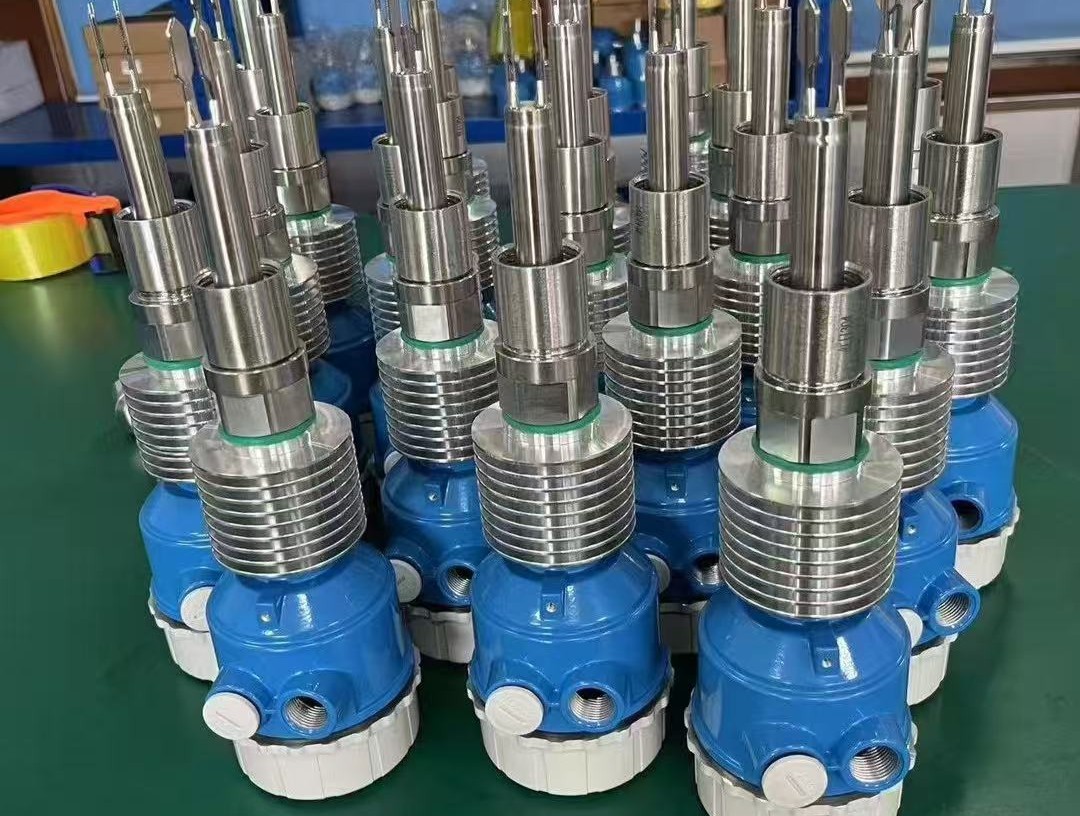
What is a Vibrating Fork Level Switch?
In the realm of modern industrial automation and process control, accurate and reliable level measurement is paramount for ensuring production efficiency, product quality, and operational safety. Traditional level switches, such as float switches or even some advanced technologies, often face significant challenges when confronted with turbulent, agitated, foamy, high-viscosity, or high-pressure environments.
The Vibrating Fork Level Switch emerges as an advanced, robust, and virtually maintenance-free solution designed to overcome these challenges. Utilising a simple yet highly effective principle—the change in vibration frequency—this sensor reliably detects the presence of liquids or solids at a specific point.
Driven by a piezoelectric element, the switch generates a stable vibration. When the two-pronged fork comes into contact with the material, the vibration frequency rapidly changes. The sophisticated electronic circuit then converts this change into an accurate ON/OFF switching signal. This design, featuring no mechanical moving parts, ensures long service life, exceptional reliability, and minimal operational costs, making it ideal for high/low level alarms and control across industries like petrochemical, food processing, and water treatment.
What is a Vibrating Fork Level Switch?
A Vibrating Fork Level Switch is a point-level measurement instrument used to detect the limit level (high or low) of media inside a tank, vessel, silo, or pipeline. It is essentially an electronic limit switch that indicates whether the material has reached the precise location where the sensor is mounted.
Core Definition and Components
Function: To provide a precise ON/OFF switching signal for tasks such as high/low level alarms, pump start/stop control, or valve activation.
Key Components: The switch consists of three main parts: the Vibrating Fork (the sensing element), the Piezoelectric Element (the driver), and the Electronic Circuit (the signal processor).
Design Advantage: Unlike mechanical switches, the fully electronic detection with no moving parts provides superior durability and high reliability over a long operational period.
Key Features Summary
| Feature | Description | Operational Benefit |
| Strong Adaptability | Detection is unaffected by the electrical properties, density, viscosity, turbulence, bubbles, or scaling of the media. | Reliable performance in a wide range of challenging media and process conditions. |
| No Calibration Required | Works accurately across various liquids and solids without the need for complex on-site calibration. | Simple installation and rapid commissioning. |
| Maintenance-Free | Fully electronic design ensures long service life and minimal operational intervention. | Low total cost of ownership (TCO) and reduced downtime. |
| Wide Operating Range | Operates reliably in extreme conditions, including temperatures from -40°C to +150°C | Versatile use in demanding industrial environments. |
How Does a Vibrating Fork Level Switch Work?
The operation of the Vibrating Fork Level Switch is based on the physical principles of frequency resonance and the damping effect caused by material contact.
1. Piezoelectric Drive and Free Oscillation
When the switch is powered up and not in contact with the process medium, the internal piezoelectric crystal is energised by the electronic circuit. This crystal converts electrical energy into mechanical energy, causing the fork arms to vibrate continuously at their specific natural resonant frequency (e.g., typically 1000 Hz or higher). The electronic circuit monitors and registers this stable, high-frequency signal.
2. Material Contact and Damping
When the level of the liquid or solid medium reaches and makes contact with the vibrating fork, the medium exerts a damping force on the fork arms. This physical resistance to movement causes the following effects:
Result: The vibration frequency drops sharply, and the amplitude of the oscillation is significantly reduced. This effect is similar to placing a vibrating tuning fork into water.
3. Signal Conversion and Output Switching
The internal electronic circuit continuously monitors the vibration frequency. Once the frequency drops below a pre-set threshold (indicating damping), the circuit recognises that the material has arrived at the sensing point.
Switching: This state change is immediately converted into an ON/OFF switch signal. The switching time is typically very fast, approximately 2 seconds when material is present.
Restoration: When the material level drops and the fork becomes uncovered, the damping effect ceases. The fork quickly returns to its natural resonant frequency, and the output signal is reset (typically within 3 seconds).
This electronic principle ensures highly reliable and accurate switching, even in environments with turbulence or foam, where traditional devices might fail.
Applications of Vibrating Fork Level Switch
The combination of high reliability and strong media compatibility makes the Vibrating Fork Level Switch essential across numerous critical industries.
Key Application Sectors
Petrochemical Industry:
Reliable high/low level detection in large storage tanks, reactors, and pipelines. Highly suited for flammable, corrosive, and high-pressure media
2. Food & Beverage Processing:
Used for hygienic, maintenance-free level control of liquids like milk, juices, beer, syrups, and semi-solid materials like sauces. The Stainless Steel construction (SS316) and hygienic connections meet strict food safety standards.
3. Water & Wastewater Treatment:
Accurate monitoring of water, sludge, chemical dosing agents, and other treatment processes. The strong anti-adhesion capabilities prevent false readings caused by sticky sludge or scaling.
4. Light Industry & Manufacturing:
Level detection in chemical storage, cosmetic, pharmaceutical, and paint production for various solvents and powdered chemicals.
5. Specialised Applications in Challenging Conditions:
Ideal for situations where agitation, tank vibration, frothing (bubbles), or turbulence would cause mechanical float switches to give unreliable readings.
Types of Vibrating Fork Level Switch
Vibrating fork switches can be categorised based on their intended medium, structural design, and output signal.
Classification by Medium
Liquid Type Switches:
Designed with standard fork geometry optimised for quick damping and response in liquids.
2. Solid/Powder Type Switches:
Often feature a single, longer vibrating rod (tuning rod) or a specifically shaped fork to ensure sufficient damping even with very low-density powders and granules.
Classification by Structure
Compact Type:
The most common design, where the electronics are integrated directly into the housing attached to the fork. Suitable for standard tank applications.
2. Extended Type:
The fork is connected to the housing via an extension tube (e.g., for reaching the bottom of a deep tank or through thick insulation) or a remote cable (Split Type).
Classification by Output
The output type determines how the switch interfaces with the control system:
Relay Output:
Provides potential-free contacts capable of directly switching high voltage/high current loads (e.g., up to AC250V/4A or DC60V/4A) to control pumps or high-power alarms.
Open Collector Output (NPN/PNP):
Provides a low-voltage DC signal (max 400 mA), suitable for direct connection to the digital input cards of a Programmable Logic Controller (PLC).
Technical Specifications Overview
| Item | Specification |
| Power Supply Voltage | 20–60 VDC / 20–250 VAC, 50/60Hz |
| Switching Time | approx 2 seconds (material present); approx 3 seconds (material absent) |
| Medium Temperature | -40°C to +150°C |
| Operating Pressure | -1 to +40 bar |
| Process Connection | G1-1/2 or G1 |
| Fork Material | SS304 / SS316 |
| Output Type | Relay Output, Open Collector NPN or PNP (max 400 mA) |
| Power Consumption | Max. 3W (DC supply); Max. 15W (AC supply) |
How to Choose the Right Vibrating Fork Level Switch?
Selecting the optimal switch requires carefully matching the sensor's specifications to your process conditions, media characteristics, and installation requirements.
Selection Checklist
| Factor | Key Considerations | Recommended Parameter |
| Media Properties | Is it a liquid or a solid? What are the density, viscosity, and corrosiveness? | Density: Ensure media density meets the minimum ( 0.7 g/cm3 for liquid). Corrosion: Select S316 for high-corrosion applications. |
| Process Conditions | The maximum and minimum temperatures and pressures inside the vessel. | Temperature: Must be within the medium temperature range (up to +150°C). Pressure: Ensure it does not exceed the maximum operating pressure of 40 bar. |
| Installation Interface | Available tank nozzle size and mounting orientation (side or top). | Process Connection: Select the appropriate threading (G1-1/2'' or G1''). Electrical Connection: Determine if an $\text{M12}$ connector is suitable. |
| Control System | What kind of load needs to be driven (pump, alarm), or is it connecting to a PLC? | Output Type: Relay for driving high-power loads; NPN/PNP for PLC inputs. |
| Ambient Environment | Is the area hot, cold, or does it require explosion-proof certification (optional)? | Ambient Temperature: Must be within -40°C to +70°C for the electronics housing. |
Vibrating Fork Level Switch Price
The price of the Vibrating Fork Level Switch varies depending on material, type, and customized specifications.
The primary factors influencing the final cost include:
Material Grade: S304 versus the premium, more chemical-resistant S316 stainless steel fork.
Structural Type: Standard compact versus extended or special solid-type designs.
Customized Specifications: Custom process connections, high-pressure/high-temperature build, or specific certifications.
Output Configuration: Relay output vs. NPN/PNP output.
For the latest quotation suitable for your specific application and technical requirements, please feel free to contact us for an updated offer.
Custom Vibrating Fork Level Switch OEM
ZINACA Instruments is a professional industrial instrumentation manufacturer, specializing in a comprehensive range of measurement devices. We are proud to offer advanced, customized OEM services for the Vibrating Fork Level Switch to perfectly align with your technical requirements and process conditions.
Our OEM Capabilities Include:
Structural Customization: Manufacturing of customized probe lengths or unique process connections to fit your vessels.
Performance Optimization: Adjusting sensitivity, pressure ratings, or temperature tolerances for extreme operating environments.
Branding and Documentation: Providing private-label manufacturing, packaging, and coordinated certification support for your brand.
If you are looking for Vibrating Fork Level Switch OEM Service, please contact ZINACA Instruments to discuss your specific needs and let us deliver reliable, high-quality solutions tailored for you.
Vibrating Fork Level Switch Manufacturer
Choosing an experienced and reliable manufacturer is critical for ensuring product quality and long-term performance.
As a leading Vibrating Fork Level Switch Manufacturer, ZINACA Instruments produces level switches known for their high sensitivity, durable construction, and long service life. We ensure stable and precise level measurement for industrial applications worldwide by adhering to stringent quality control and manufacturing standards.
Contact ZINACA Instruments today to learn more about our product line, discuss your specific application, and receive a competitive quote.
 WhatsApp
 Email
Email
 +8617320288925