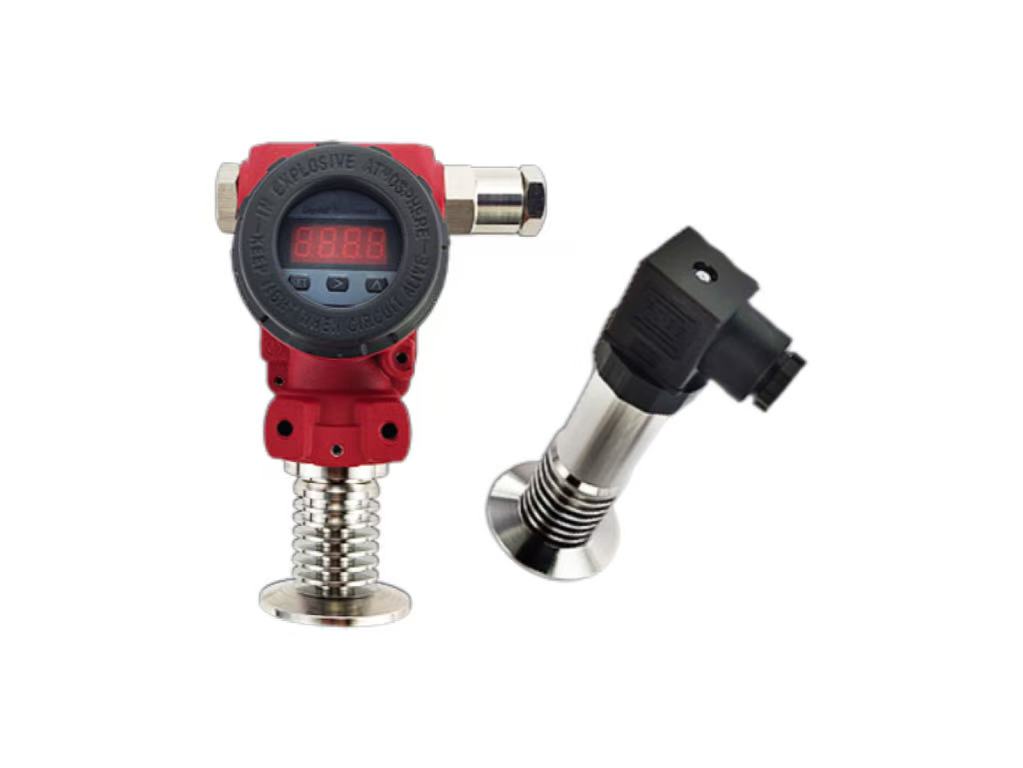
Why is My Pressure Transmitter Inaccurate? A Complete Diagnostic Guide
In industrial process control, the Pressure Transmitter is the "eyes" of the system. However, even high-precision instruments can encounter issues due to harsh environments or improper installation. At ZINACA Instruments, we believe that understanding these common failures is the first step toward maintaining a stable and efficient production line.
Below is a professional guide to diagnosing and fixing the most frequent pressure transmitter failures.
1. Fluctuating or Unstable Pressure Readings
If your pressure display is jumping up and down unpredictably, follow these diagnostic steps:
Check the Process Load: Compare the pressure reading with other parameters like temperature, flow, or liquid level. If those are also fluctuating, the issue is likely a real change in process load, and the transmitter is simply doing its job.
Inspect the Control Loop: If only the pressure is fluctuating, check the control valve. Is the positioner output constant? If the valve is oscillating, the problem lies with the valve. If the valve is steady, the issue is likely the transmitter or its wiring.
Zero-Point Test: Close the pressure source and open the vent to atmospheric pressure. If the transmitter displays a perfect "0," the sensor itself is likely functional.
Wiring and Interference: Check the cable shielding from the field junction box to the DCS cabinet. Fluctuations are often caused by broken shields, loose connections, or oxidized wire cores. In environments with high electromagnetic interference (EMI), poor shielding will lead to severe signal noise.
Steam Media Specifics: For steam measurement, check the condensation in the impulse lines. If you use heat tracing, ensure the tracing temperature isn't too high, and the distance between the tracing and the impulse line isn't too close. Excessive heat can cause the condensate to vaporize, leading to measurement instability.
2. No Display or Zero Signal Output
A complete lack of signal usually points to a total circuit failure:
Check for Open Circuits: The most common cause is loose wiring or a broken cable.
DCS Diagnosis: Different DCS systems behave differently during an open circuit (some show "Bad," others show "Downscale"). Use these alerts to pinpoint the location of the break.
Step-by-Step Inspection: Systematically check every connection point from the terminal cabinet to the field junction box and finally the transmitter's own terminals.
3. Frozen Readings (No Change with Process Activity)
If the pressure reading remains static despite obvious changes in the process, the issue is usually a physical blockage:
Impulse Line Blockage: Inspect the entire path from the primary tapping valve to the transmitter. In systems transporting powders or granules, material can easily accumulate in the "dead zones" of the impulse piping. Over time, this buildup hardens and prevents the pressure signal from reaching the sensor.
Valve Status: Ensure the isolation valves are fully open and not stuck in a closed or partially blocked position.
4. Significant Measurement Deviations (Inaccuracy)
When the transmitter provides a stable reading that is clearly wrong, perform the following:
Zero Drift: Check if the transmitter’s zero point has shifted. Long-term use or extreme temperature cycles can cause "Zero Drift." If this is the case, a simple re-zeroing of the device is required.
Linearity Check: Use a standard pressure source (like a deadweight tester or a high-precision calibrator) to perform a multi-point calibration. If the output is no longer linear, the sensing diaphragm may be damaged or fatigued.
Why Quality Matters: The ZINACA Advantage
At ZINACA Instruments, we design our pressure transmitters to minimize these common failures. By utilizing monocrystalline silicon sensors and isolated digital microprocessors, our transmitters offer superior resistance to zero drift and electromagnetic interference.
Our all-stainless steel construction and IP65/IP67 ratings ensure that moisture and corrosion—the leading causes of wiring oxidation and sensor failure—are kept at bay.
Custom OEM Services and Support
If you are facing persistent transmitter failures, it may be time to upgrade to a more robust sensing solution. ZINACA offers:
Customizable Impulse Connections to prevent clogging in powder systems.
Advanced HART Communication for remote diagnostics and easier calibration.
Explosion-Proof Designs for hazardous environments.
 WhatsApp
 Email
Email
 +8617320288925