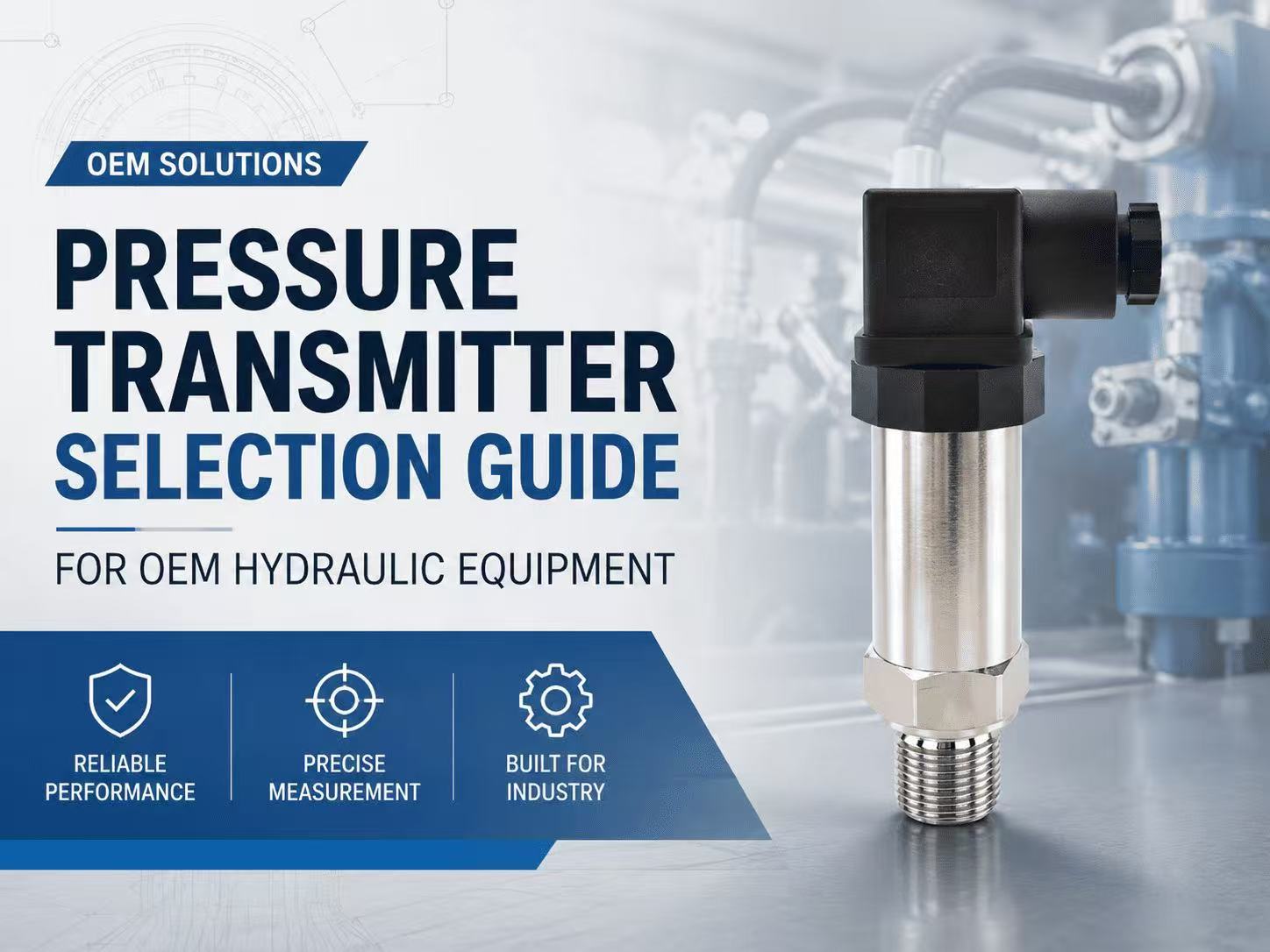
Pressure Transmitter Guide for OEM Hydraulics
Pressure Transmitter Selection Guide for OEM Hydraulic EquipmentIntroduction
For OEM hydraulic equipment, pressure transmitters are not only measuring devices. They help protect pumps, cylinders, valves, and control systems by converting hydraulic pressure into a stable electrical signal. If the wrong range, connection, material, or output signal is selected, the result may be unstable readings, leakage risk, short service life, or unnecessary purchasing cost.
For equipment manufacturers, distributors, and project buyers, correct pressure transmitter selection should start from real working conditions, not only from a model number. This guide explains the main parameters to confirm before purchasing pressure transmitters for hydraulic machinery and OEM equipment.
Application Overview
Pressure transmitters are widely used in hydraulic power units, presses, injection molding machines, lifting equipment, agricultural machinery, test benches, lubrication systems, and automated production equipment. In these systems, the transmitter measures the pressure of hydraulic oil or related media and sends a signal to PLCs, controllers, displays, or data acquisition systems.
Typical functions include:
Monitoring pump outlet pressure
Controlling cylinder force
Detecting overload or abnormal pressure rise
Supporting closed-loop hydraulic control
Providing pressure data for equipment diagnostics
Replacing mechanical gauges in automated systems
Hydraulic applications usually involve pressure pulsation, vibration, oil temperature changes, and compact installation space. Therefore, the transmitter must be selected according to both measuring requirements and mechanical installation conditions.
Key Parameters to Confirm Before Selection
| Parameter | What to Confirm | Why It Matters |
|---|---|---|
| Medium | Hydraulic oil, lubrication oil, water-glycol, or other fluid | Determines wetted material compatibility and sealing structure |
| Measuring range | Normal working pressure and maximum system pressure | Avoids overload while keeping useful signal resolution |
| Working pressure | Continuous pressure and possible peak pressure | Hydraulic systems often have pressure spikes |
| Flow rate | Approximate system flow and pulsation condition | Helps judge whether pressure fluctuation or shock may affect the measurement |
| Pipe size | Hydraulic line size or mounting position | Helps confirm the adapter, tee, or mounting method |
| Process connection | G1/4, M20x1.5, NPT, or customized thread | Ensures correct mechanical installation and sealing |
| Output signal | 4–20 mA, 0–10 V, 0–5 V, or other signal | Must match PLC, controller, or display input |
| Power supply | Commonly 12–36 VDC or project-specified supply | An incorrect supply voltage may damage the transmitter |
| Accuracy | Required accuracy class for control or monitoring | Higher accuracy may increase cost and may not be necessary for simple protection |
| Wetted material | Stainless steel, seal material, diaphragm material | Must be suitable for the medium and temperature |
| Working temperature | Medium temperature inside the hydraulic system | Affects sensor stability and seal selection |
| Ambient temperature | The temperature around the equipment or control cabinet | Important for outdoor or high-temperature machinery |
| Installation method | Vertical, horizontal, compact installation, vibration area | Influences cable outlet, connector type, and mechanical durability |
| Explosion-proof requirement | Whether the equipment operates in hazardous areas | Must be confirmed before quotation if required |
| Protection grade | IP65, IP67, or project requirement | Important for outdoor, dusty, or wet environments |
| Quantity | Prototype quantity and batch order quantity | Affects production planning and quotation structure |
| Destination country | Final market or installation country | Helps confirm thread preference, documentation, and shipping quotation |
Recommended Product Solution
For most OEM hydraulic equipment, a compact pressure transmitter with stainless steel wetted parts, stable electrical output, and a rugged process connection is usually suitable. The common output signals are 4–20 mA for longer cable runs and industrial control systems, or 0–10 V / 0–5 V for compact equipment controllers.
For hydraulic systems with strong vibration or pressure shock, buyers should pay attention to overload capacity, mechanical strength, and installation position. If the pressure line has severe pulsation, a damping structure or pressure snubber may be considered according to the application.
For equipment installed outdoors or in harsh industrial environments, the protection grade and electrical connector should be confirmed carefully. Cable outlet, DIN connector, M12 connector, and other wiring methods may be selected depending on the machine design.
If the medium is standard hydraulic oil and the temperature is within a normal industrial range, stainless steel wetted parts are commonly used. If the fluid is special, corrosive, or mixed with additives, the medium details should be provided before model selection.
ZINACA Instruments can support OEM buyers with pressure transmitter model selection based on the actual hydraulic system parameters, required signal, connection standard, and batch purchasing plan.
Common Selection Mistakes
Selecting only by maximum pressure
Some buyers choose the transmitter range only according to the maximum pump pressure. In practice, the normal working pressure should also be considered. If the range is too high, the output signal may not provide enough useful resolution.Ignoring pressure peaks
Hydraulic systems may generate short pressure spikes during valve switching, cylinder movement, or pump start-up. If overload capacity is not considered, the sensing element may be damaged.Choosing the wrong output signal
A transmitter with a 4–20 mA output cannot be connected in the same way as a voltage-output transmitter. The PLC or controller input type must be confirmed before purchasing.Not confirming the thread and sealing method
G thread, NPT thread, and metric thread have different sealing methods. A wrong process connection can cause leakage or installation delays.Over-specifying accuracy
High accuracy is important for test benches and precision control, but simple pressure monitoring may not require the highest accuracy class. Matching accuracy to the application helps control cost.Forgetting the environment
Oil mist, water spray, dust, vibration, and ambient temperature can affect transmitter performance. Protection grade and connector type should match the machine environment.Missing destination country information
For export orders, the destination country affects shipping, documentation, labeling, and sometimes preferred connection standards.
Inquiry Checklist for Quotation
Before requesting a quotation, please prepare the following information:
Medium
Measuring range
Normal working pressure and maximum pressure
Working temperature
Ambient temperature
Process connection
Pipe size or installation position
Output signal
Power supply
Accuracy requirement
Wetted material requirement
Electrical connection or cable requirement
Installation method
Protection grade requirement
Explosion-proof requirement, if any
Quantity for sample order and batch order
Destination country
Any drawing, photo, or existing model reference, if available
Providing these details helps avoid repeated communication and supports faster technical selection.
FAQs
1. What pressure range should I choose for a hydraulic pressure transmitter?
The range should cover the normal operating pressure and the possible maximum pressure. For hydraulic systems with pressure spikes, a suitable safety margin should be considered. If the range is too low, overload risk increases; if it is too high, measurement resolution may be reduced.
2. Is 4–20 mA or 0–10 V better for OEM hydraulic equipment?
Both are commonly used. A 4–20 mA signal is suitable for industrial control systems and longer transmission distances. Voltage output is often used in compact machines and controllers. The correct choice depends on the input type of your PLC, controller, or display.
3. Which process connection is commonly used?
Common options include G1/4, M20x1.5, NPT threads, and other project-specific connections. The final selection should match the hydraulic block, pipe adapter, or equipment design. The thread standard and sealing method must be confirmed before production.
4. Can one pressure transmitter model be used for different hydraulic machines?
It is possible if the pressure range, output signal, process connection, power supply, medium, and environmental conditions are the same. For OEM production, standardizing one model can reduce purchasing complexity, but each machine type should still be checked technically.
5. What information is most important for a fast quotation?
The most important details are medium, measuring range, process connection, output signal, power supply, accuracy, working pressure, temperature, material requirement, quantity, and destination country. Photos or drawings are also helpful when replacing an existing transmitter.
Conclusion
Selecting a pressure transmitter for OEM hydraulic equipment requires more than matching a pressure range. Buyers should confirm the medium, pressure conditions, thread connection, output signal, power supply, material compatibility, temperature, protection grade, and installation environment. For batch OEM projects, stable specifications and clear quotation data can reduce purchasing risk and simplify future production.
To help select the correct model, please send us your medium, measuring range, process connection, output signal, working pressure, temperature, material requirements, quantity, and destination country. ZINACA Instruments can support model selection and provide a technical quotation.
 WhatsApp
 Email
Email
 +8617320288925