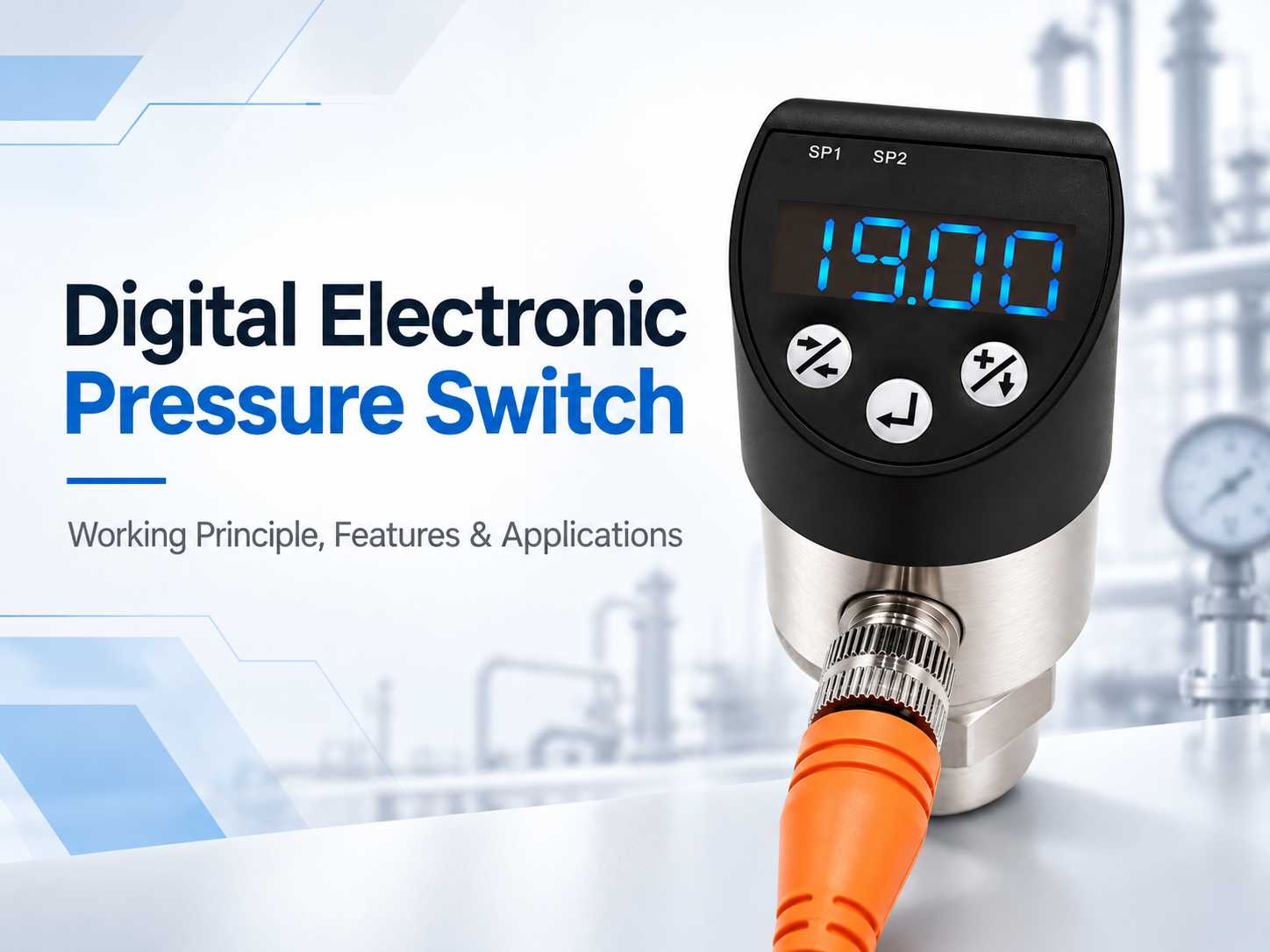
What Is a Digital Electronic Pressure Switch? Working Principle, Features & Applications
In modern industrial automation, accurate pressure monitoring is essential for maintaining equipment performance, process stability, and operational safety. From hydraulic power units and pneumatic systems to industrial pumps and compressors, pressure control plays an important role in everyday operations.
A digital electronic pressure switch combines pressure measurement, programmable switching functions, and electronic signal transmission in one compact device. Unlike conventional mechanical pressure switches, digital models allow operators to configure switching points, monitor real-time pressure values, and integrate pressure information into automated control systems.
In this article, we explain how digital electronic pressure switches work, their key advantages, common industrial applications, and important factors to consider when selecting the right model.
What Is a Digital Electronic Pressure Switch?
A digital electronic pressure switch is an intelligent pressure monitoring instrument designed to detect pressure changes in liquids or gases and activate electronic outputs when predefined pressure thresholds are reached.
The device typically integrates a pressure sensing element, electronic signal processing circuitry, a digital display, and configurable switching outputs.
Depending on the model, additional functions may include analog output, communication interfaces, switching delays, and adjustable hysteresis.
For example, the ZINACA ZNC-PS7865 Digital Electronic Pressure Switch combines dual PNP switching outputs, a 4-20mA analog output, and optional RS485 Modbus communication.
This multifunctional design allows one instrument to provide local pressure indication, switching control, and continuous pressure feedback for industrial automation applications.
How Does a Digital Electronic Pressure Switch Work?
The working principle of a digital electronic pressure switch involves pressure sensing, electronic signal processing, and programmable output control.
1. Pressure Detection
When pressure is applied to the sensing diaphragm, the sensor detects the resulting physical change and converts it into an electrical signal.
The ZNC-PS7865 uses a stainless steel diaphragm with a welded construction, providing a robust pressure-sensing interface for compatible liquid and gas applications.
2. Signal Processing
The electrical signal is processed by an internal electronic control circuit.
The ZNC-PS7865 incorporates an industrial-grade ARM microcontroller and high-precision analog-to-digital conversion technology to process the sensor signal and determine the measured pressure.
The pressure reading is then presented on the digital LED display.
3. Switching Control
The measured pressure is continuously compared with the configured switching thresholds.
When the pressure reaches a programmed switching point, the corresponding electronic output changes state according to the selected switching logic.
For example, in a hydraulic system, one switching output may be configured to indicate insufficient pressure, while another can provide a high-pressure alarm.
Both switching points can be configured to match the operating requirements of the equipment.
4. Analog Signal Transmission
In addition to switching control, a digital pressure switch equipped with a 4-20mA output can continuously transmit pressure information to a PLC, controller, or monitoring system.
This enables both threshold-based control and continuous pressure measurement using a single instrument.
Key Features of the ZINACA ZNC-PS7865 Digital Pressure Switch
The ZNC-PS7865 is designed for industrial pressure monitoring applications requiring flexible electronic outputs and convenient field configuration.
Dual PNP Switching Outputs
The instrument provides two configurable PNP switching outputs, allowing independent pressure switching functions.
Users can configure:
Adjustable pressure switching points
Normally Open (NO) or Normally Closed (NC) logic
Hysteresis or window switching modes
Switching delays from 0 to 1000 seconds
These functions are useful for pressure limit monitoring, equipment operating status detection, and automated process control.
Hysteresis settings help avoid repeated switching when pressure fluctuates around a threshold, while window mode allows monitoring within a defined pressure band.
4-20mA Analog Output and Optional RS485 Communication
The ZNC-PS7865 supports a 4-20mA analog output for continuous pressure transmission.
For applications requiring digital communication, RS485 Modbus is also available through an optional output configuration.
This provides integration flexibility for PLC-based automation systems, industrial monitoring equipment, and OEM machinery.
The communication option and connector configuration should be confirmed when ordering.
Fast Switching Response
With a specified switching response time of less than 10 ms, the instrument is suitable for applications requiring rapid detection of pressure threshold changes.
The actual response of the complete control system also depends on the controller, connected equipment, and configured switching delay.
Digital LED Display and Adjustable Housing
The instrument features a high-brightness blue LED display and two red switching status indicators.
Three front-panel buttons allow users to configure switching points and operating parameters without requiring a separate programming device.
The housing can rotate up to 330 degrees, while the display supports 180-degree orientation adjustment.
These features make it easier to install and read the instrument in different mounting positions.
Compact Industrial Construction
The ZNC-PS7865 is designed for use in industrial machinery and automation equipment.
Key technical specifications:
| Parameter | Specification |
|---|---|
| Pressure Range | Multiple ranges available, up to 60 MPa |
| Power Supply | 12-30 VDC |
| Switching Outputs | 2 x PNP |
| Analog Output | 4-20mA |
| Communication | RS485 Modbus (Optional) |
| Switching Response | Less than 10 ms |
| Switching Modes | Hysteresis / Window |
| Protection Rating | IP65 |
| Operating Temperature | -30°C to +80°C |
| Medium Temperature | -30°C to +80°C |
| Electrical Connection | M12 x 1 Connector |
| Process Connection | G1/4 Male; Other Connections Available |
The available pressure range, process connection, and electrical configuration should be selected according to the application requirements.
Industrial Applications of Digital Electronic Pressure Switches
Digital electronic pressure switches are widely used in industrial automation systems where pressure measurement and switching control are both required.
Hydraulic Systems
Hydraulic equipment relies on appropriate operating pressure to maintain consistent performance.
Digital pressure switches can monitor hydraulic pressure and provide electrical signals for low-pressure warnings, high-pressure alarms, or operating status detection.
Typical applications include hydraulic power units, industrial presses, and machine tools.
Pneumatic Systems
In pneumatic automation, pressure switches are commonly installed to monitor compressed air supply pressure.
They can help identify pressure falling below the required operating level and transmit status information to a PLC or machine controller.
Applications include automated production lines, pneumatic actuators, and air distribution equipment.
Pumps and Water Pressure Systems
Industrial pumps often require pressure monitoring to detect abnormal operating conditions.
A digital electronic pressure switch can be configured to monitor minimum and maximum pressure limits.
For example, one output may indicate a low-pressure condition, while the second output provides a high-pressure alarm.
The 4-20mA output can simultaneously provide continuous pressure information to the control system.
Air Compressors
Digital pressure switches can be integrated into air compressor monitoring and control systems.
Programmable switching points allow the equipment controller to detect pressure thresholds and respond according to its programmed operating sequence.
OEM Machinery and Industrial Automation
For original equipment manufacturers, compact multifunctional pressure instruments can simplify system design.
Instead of installing separate devices for pressure indication, switching, and analog transmission, a compatible digital pressure switch can consolidate these functions.
This makes digital models useful for machine builders, system integrators, and industrial automation equipment manufacturers.
Digital vs. Mechanical Pressure Switches: What Is the Difference?
Both digital and mechanical pressure switches are designed to detect pressure thresholds, but they differ in operation and functionality.
| Feature | Digital Pressure Switch | Mechanical Pressure Switch |
|---|---|---|
| Pressure Detection | Electronic Sensor | Mechanical Sensing Element |
| Switching Adjustment | Electronic Configuration | Mechanical Adjustment |
| Local Display | Commonly Available | Usually Not Integrated |
| Analog Output | Available on Selected Models | Generally Unavailable |
| Multiple Setpoints | Supported on Selected Models | Depends on Design |
| External Power | Normally Required | Often Not Required for Switching |
| Control Integration | Suitable for PLC Systems | Suitable for Conventional Switching Circuits |
Mechanical pressure switches remain practical for basic control applications where simplicity and operation without an external electronic power supply are priorities.
Digital electronic pressure switches offer additional flexibility where adjustable settings, continuous pressure feedback, and automation integration are required.
How to Select the Right Digital Electronic Pressure Switch
Choosing a suitable digital pressure switch requires matching its technical specifications to the operating conditions of the system.
Pressure Measurement Range
Identify the normal operating pressure, required switching points, and maximum possible process pressure.
Select an appropriate measurement range while considering potential pressure spikes and the instrument's allowable overload limits.
Measuring Medium
Confirm whether the instrument will be exposed to water, hydraulic oil, compressed air, or another gas or liquid.
For corrosive or chemically aggressive media, the compatibility of the wetted materials must be verified before selection.
Electrical Output Requirements
Determine whether the control system requires PNP switching outputs, a 4-20mA analog signal, or a digital communication interface.
The ZNC-PS7865 offers dual PNP outputs and 4-20mA transmission, with RS485 Modbus available as an optional configuration.
Process and Electrical Connections
Confirm the process thread and the required electrical connector.
The ZNC-PS7865 datasheet illustrates a G1/4 male process connection and an M12 x 1 electrical connector, with different connector pin configurations depending on the selected outputs.
Operating Conditions
Check the medium temperature, ambient temperature, environmental protection requirements, and mounting conditions.
For the ZNC-PS7865, the specified operating and medium temperature range is -30°C to +80°C, with IP65 protection.
Frequently Asked Questions (FAQ)
Can a digital pressure switch provide both switching and analog outputs?
Yes. Certain digital electronic pressure switches support both functions. The ZINACA ZNC-PS7865 provides two PNP switching outputs and a 4-20mA analog output, enabling threshold detection and continuous pressure transmission.
What is the advantage of dual PNP outputs?
Dual PNP outputs allow two switching functions to be configured independently. For example, one output can be assigned to a low-pressure warning and the other to a high-pressure warning.
Does the ZNC-PS7865 support Modbus communication?
RS485 Modbus communication is available as an optional configuration. Customers should confirm the required communication function and corresponding connector configuration before ordering.
Can a digital electronic pressure switch be connected to a PLC?
Yes. A compatible PLC can receive the electronic switching signals and 4-20mA analog output. The PLC input type, supply voltage, and wiring arrangement must match the pressure switch specifications.
Can digital pressure switches replace mechanical pressure switches?
In many pressure monitoring applications, digital pressure switches can provide an alternative to mechanical models. However, electrical power requirements, output compatibility, environmental conditions, and control-system requirements must be checked before replacement.
Conclusion
A digital electronic pressure switch offers an efficient way to combine pressure monitoring, configurable switching control, and signal transmission in modern industrial equipment.
With features such as dual PNP outputs, 4-20mA analog transmission, adjustable pressure setpoints, and optional RS485 Modbus communication, the ZINACA ZNC-PS7865 provides flexible functionality for hydraulic systems, pneumatic equipment, pumps, compressors, and industrial automation applications.
For equipment manufacturers, system integrators, and industrial instrument distributors, selecting the correct pressure range, connection, and output configuration is essential for reliable system integration.
Contact ZINACA for Digital Pressure Switch Solutions
Looking for a reliable digital electronic pressure switch for your industrial application?
ZINACA Instruments provides pressure measurement and control instruments for industrial automation applications, with available configurations to match different project requirements.
Explore ourZNC-PS7865 Digital Electronic Pressure Switchfor detailed technical information and available configurations.
For product selection, technical information, or quotations, please contact our sales team.
Tianjin ZINACA Intelligent Equipment Co., Ltd.
Email:sales@zinacainstruments.com
Website:www.zinacainstruments.com
 WhatsApp
 Email
Email
 +8617320288925